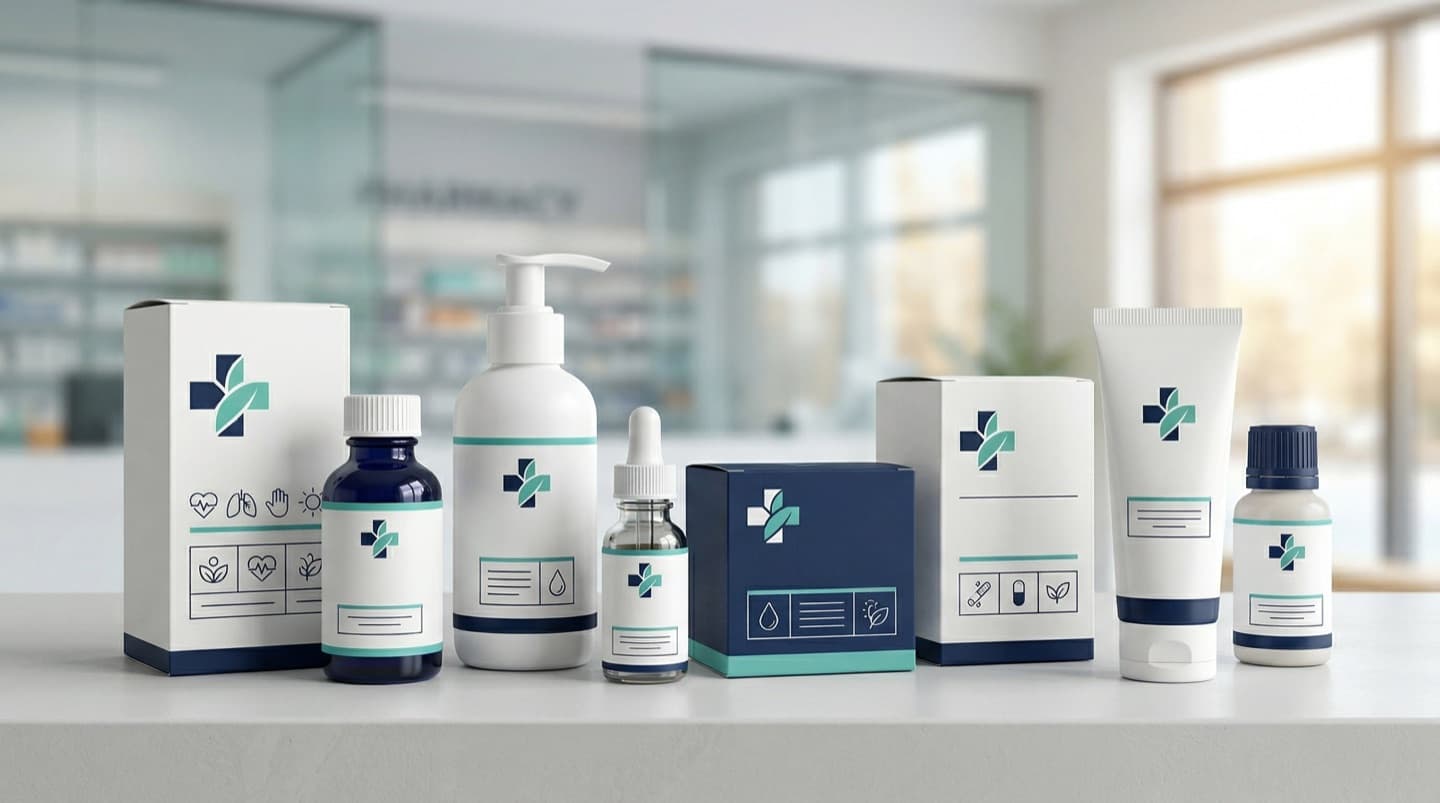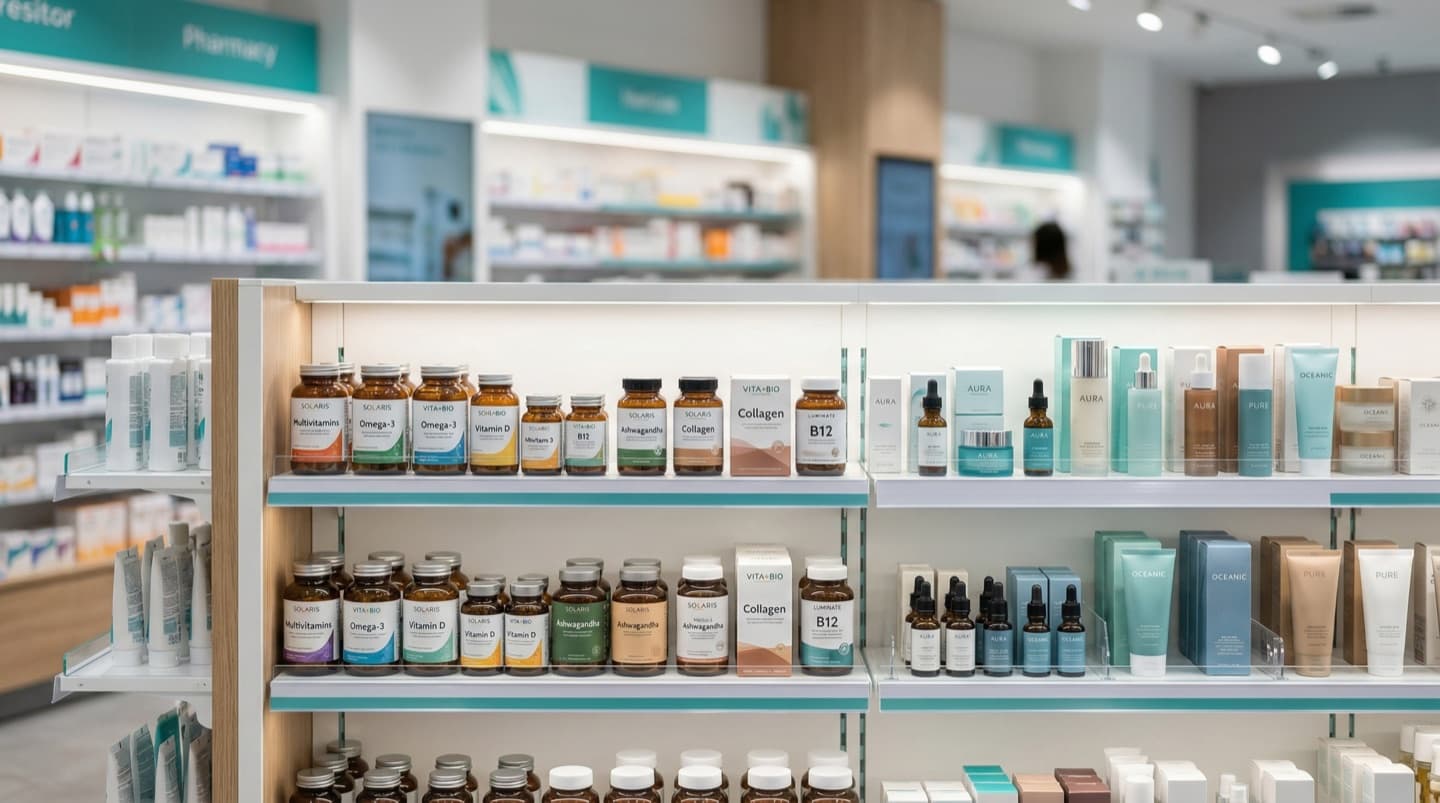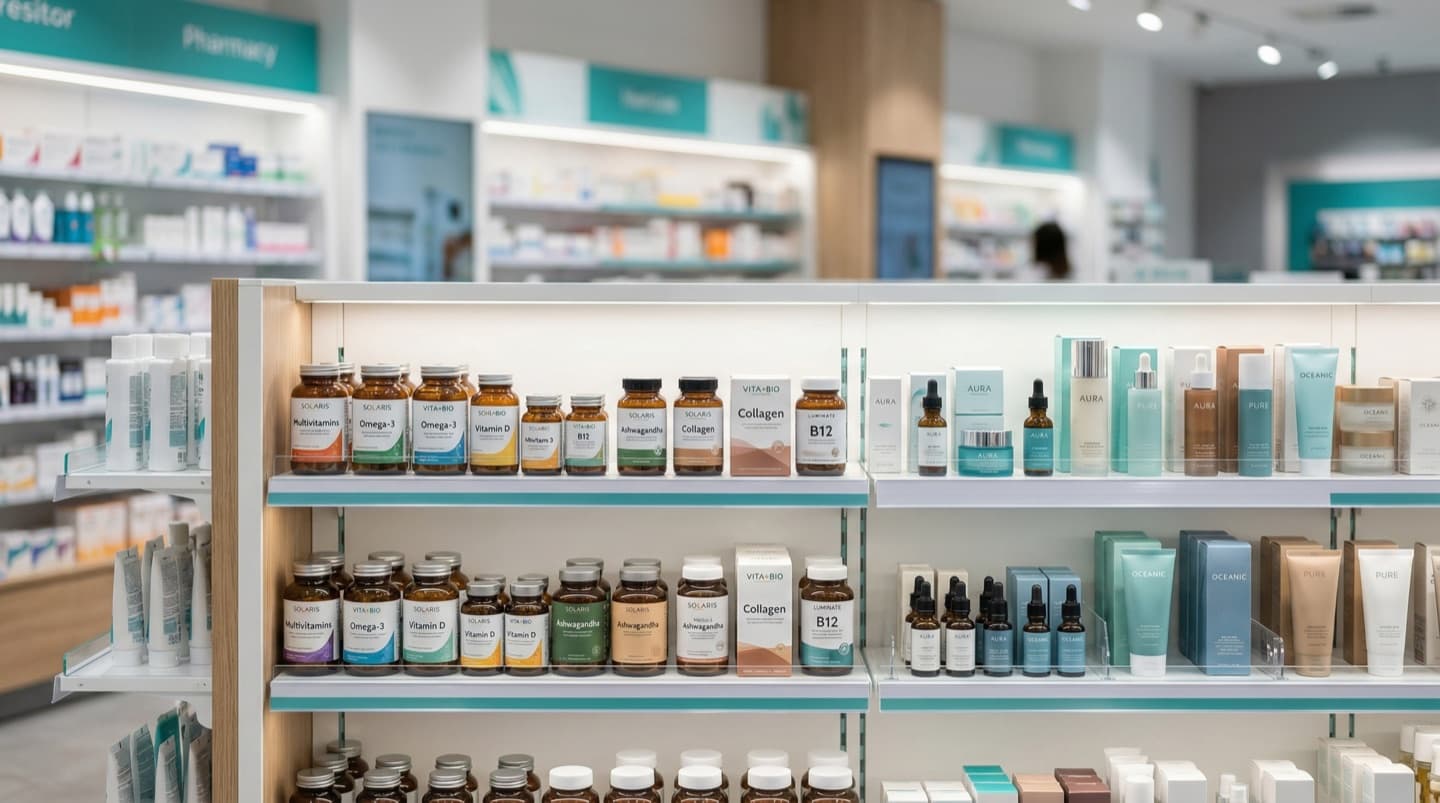
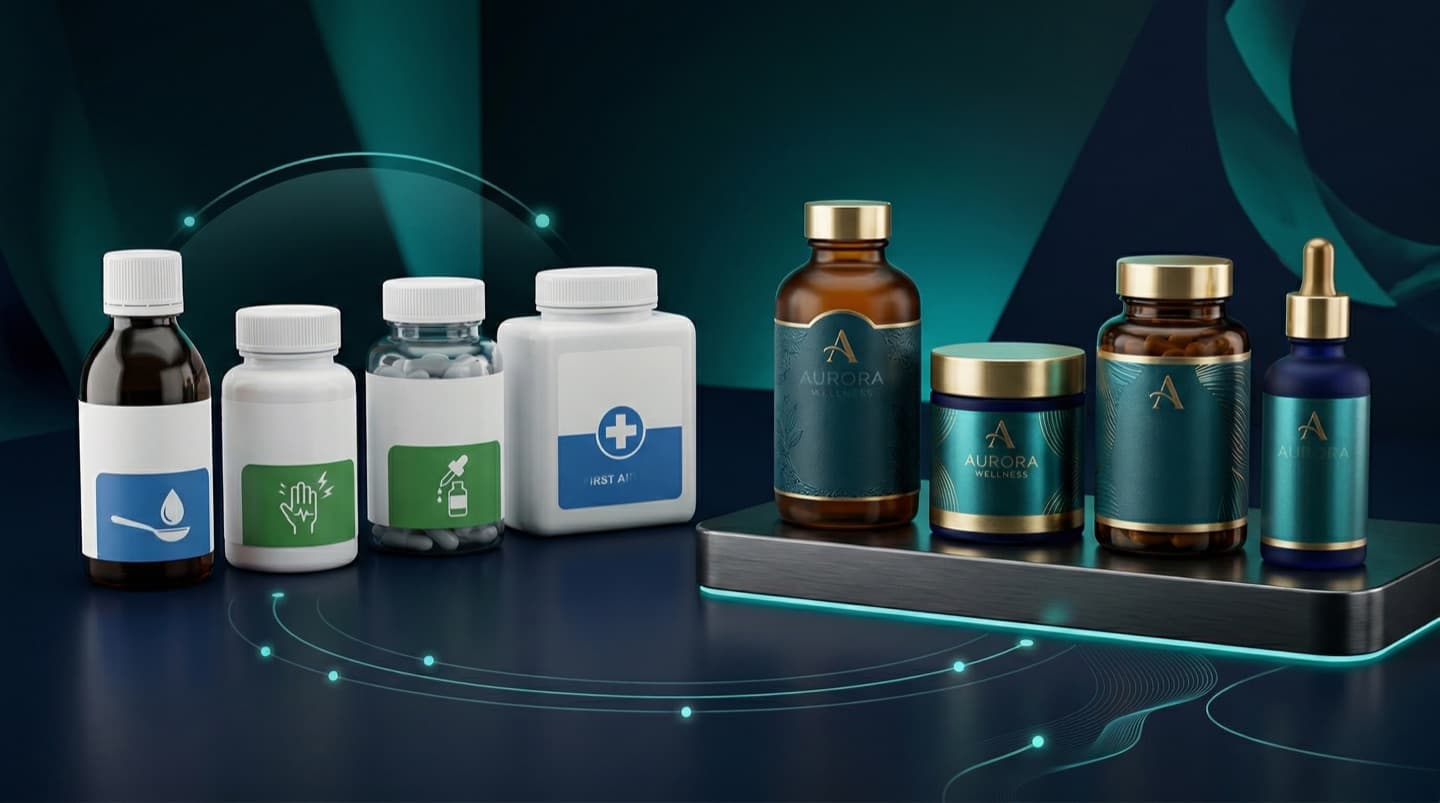
If you have spent any time walking the aisles of a Nahdi, Al-Dawaa, or Whites pharmacy in the past two years, you have noticed something that would have been unthinkable a decade ago: store-branded vitamins, supplements, personal care products, and even first-aid supplies sitting right next to — and often in front of — the global brands that have dominated GCC pharmacy shelves for decades.
This is not a passing trend. It is a structural shift in how pharmacy retail works in the Middle East, and it carries profound implications for every branded OTC, consumer healthcare, and dermo-cosmetic company operating in the region.
I have been on both sides of this equation. I have launched branded products into pharmacy chains where private label was emerging as a competitive force, and I have watched the category management conversations change from “how much shelf space does the brand deserve?” to “how does the brand justify its existence next to our own product at 30% less?” After more than 20 years in GCC pharma and consumer healthcare marketing, I can tell you that private label is not just a pricing challenge — it is a fundamental rethinking of the brand-retailer relationship.
This article is a comprehensive analysis of what is happening, why it matters, and what branded pharma companies need to do about it.
40–60%
Gross margin on pharmacy private label vs. 20–30% for branded
30%
Lower retail price of typical private label vs. branded equivalent
3×
Faster growth in vitamins/supplements private label vs. category
2027
Year by which every major GCC pharmacy chain is expected to have a private label portfolio
What Private Label Means in a Healthcare Context
Before we go further, let us define what we are talking about. Private label — also called own brand, store brand, or house brand — refers to products manufactured by a third-party contract manufacturer but sold under the retailer’s own brand name. The retailer owns the brand, controls the marketing, sets the price, and captures the margin. The manufacturer remains invisible to the consumer.
In FMCG, this has been a mature model for decades. Tesco, Walmart, Carrefour, and countless others generate significant revenue from their own brands. But in healthcare and pharmacy, private label has historically been slower to gain traction — for good reason. Healthcare products carry a higher trust threshold. Consumers want to know who made their medicine, their supplements, their skin treatments. The stakes feel different when health is on the line.
What has changed in the GCC is that pharmacy chains have invested heavily in overcoming that trust gap. They have built quality assurance programs, secured SFDA registrations, partnered with reputable contract manufacturers, and leveraged the trust that consumers already place in the pharmacy brand itself. When a customer trusts Nahdi as a pharmacy, extending that trust to “Nahdi Vitamin C” becomes a much shorter leap than it would be for a generic, unbranded product from an unknown company.
The Rise of Pharmacy Own-Brand Products in the GCC
The GCC pharmacy private label story is still in its early chapters compared to mature markets like the US or UK, but the growth trajectory is steep. Here is what the landscape looks like across the major chains.
Nahdi Medical Company
Nahdi is the largest pharmacy chain in Saudi Arabia with over 1,200 stores and a dominant e-commerce platform. Their private label program is the most developed in the region. They have steadily expanded their own-brand portfolio across vitamins, supplements, personal care, baby care, and beauty. Nahdi’s private label products are positioned as quality equivalents to branded alternatives at a more accessible price point, typically 25–35% below the branded equivalent.
What makes Nahdi’s approach particularly effective is their ability to use first-party data from their loyalty program — “Nuhdeek” — to identify which branded products have the highest repeat purchase rates and price sensitivity, and then develop private label alternatives in precisely those segments. This is a data-driven approach that few branded companies have the tools to replicate.
Al-Dawaa Pharmacies
Al-Dawaa, with its extensive network across the Kingdom, has taken a somewhat different approach. Their own-brand products tend to concentrate in personal care, hygiene, and wellness supplements. While not as broad as Nahdi’s portfolio, Al-Dawaa has been strategic about entering high-volume, high-frequency categories where brand switching costs for consumers are low. Hand sanitizers, cotton products, basic supplements, and personal hygiene items are categories where Al-Dawaa’s house brands have gained noticeable traction.
Whites (ASTER Group)
Whites, which operates primarily in the UAE market, has leveraged the ASTER Group’s broader healthcare ecosystem to build credibility for its store brands. The integration with clinical services gives Whites an advantage in positioning its own products as “clinically informed” choices. Their private label range spans supplements, first aid, and basic OTC products.
Broader Regional Trends
Beyond the big three, we are seeing private label activity from Bin Sina in the UAE, Saudi German Health pharmacies, and even emerging e-pharmacy platforms that see own-brand as a margin play from day one. The trend is moving in one direction, and it is accelerating.
| Chain | Primary Market | Private Label Focus Categories | Pricing vs. Branded | Maturity Level |
|---|---|---|---|---|
| Nahdi | KSA | Vitamins, supplements, personal care, baby care, beauty | 25–35% below | Advanced |
| Al-Dawaa | KSA | Personal care, hygiene, wellness supplements | 20–30% below | Growing |
| Whites (ASTER) | UAE | Supplements, first aid, basic OTC | 20–30% below | Emerging |
| Bin Sina | UAE | Personal care, wellness | 25–35% below | Early stage |
Why Pharmacy Chains Are Investing in Private Label
The motivations for pharmacy chains to build private label programs are not mysterious, but they are multifaceted. Understanding them is essential for branded companies that want to craft an effective response.
1. Margin Expansion
This is the most obvious driver. When a pharmacy chain sells a branded product, the gross margin typically ranges from 18–28%, depending on the category, the brand’s negotiating power, and the trade terms. When the same chain sells its own private label product in the same category, the gross margin can reach 40–55%. The math is simple and compelling. A chain that shifts even 10% of its revenue from branded to private label products can materially improve its bottom line without opening a single new store.
2. Customer Loyalty and Differentiation
In a market where Nahdi, Al-Dawaa, and others sell many of the same branded products at comparable prices, private label is one of the few tools for genuine differentiation. A customer who buys and trusts “Nahdi Vitamin D” has a reason to keep shopping at Nahdi that goes beyond price and convenience. The private label product becomes an anchor that deepens the relationship between the retailer and the shopper.
3. Control Over the Value Chain
Branded manufacturers control their supply, pricing, and promotional calendars. This creates dependency for retailers. By developing private label alternatives, chains reduce their dependency on any single supplier. If a branded manufacturer raises prices, reduces trade terms, or experiences a supply disruption, the chain has a fallback. Private label gives the retailer strategic leverage in every negotiation.
4. Category Gap Filling
Sometimes the motivation is not about replacing branded products but about serving unmet demand. If no branded player offers a specific formulation, dosage form, or price point that consumers are asking for, the retailer can fill that gap with its own product faster than waiting for a brand to develop one.
| Driver | Benefit to Retailer | Threat Level to Branded |
|---|---|---|
| Margin expansion | 40–55% gross margin vs. 18–28% on branded | High |
| Customer loyalty | Unique products drive repeat visits | Medium-High |
| Supply chain control | Reduced dependency on branded suppliers | Medium |
| Category gap filling | Faster response to unmet demand | Low-Medium |
GCC Market Analysis
Private Label Disruption by Category — GCC Pharmacy Retail
Disruption score out of 10 — red = high vulnerability, teal = defensible with brand equity and clinical differentiation
Categories Most Impacted by Private Label in GCC Pharmacies
Not all OTC and consumer healthcare categories are equally vulnerable to private label disruption. The categories where private label thrives share a few common characteristics: they are high-volume, relatively low complexity, have low emotional attachment to specific brands, and the consumer perceives the active ingredients or formulations as essentially interchangeable.
Vitamins and Supplements
This is the category with the highest private label penetration in GCC pharmacies. Vitamin C, Vitamin D, multivitamins, zinc, and omega-3 products are seen by many consumers as commodities. The thinking is straightforward: “Vitamin D is Vitamin D — why pay double for a brand name?” Private label has been devastatingly effective in this space. In mature markets like the US, store-brand vitamins already account for over 20% of category sales by volume.
Personal Care and Hygiene
Cotton pads, cotton buds, hand sanitizers, wet wipes, and basic skincare items (cleansers, moisturizers) are fertile ground for private label. These products are consumed frequently, the purchase decision is largely driven by price and availability, and the performance difference between brands is minimal from the consumer’s perspective.
Oral Care
Toothbrushes, basic toothpaste, mouthwash, and dental floss are seeing increasing private label competition. While premium oral care brands with patented technologies maintain defensibility, the mid-tier and basic segments are vulnerable. A pharmacy own-brand toothbrush at SAR 8 versus a branded one at SAR 15 is a compelling proposition for a price-conscious consumer.
First Aid and Basic Medical Supplies
Bandages, adhesive strips, antiseptic solutions, thermometers, and basic wound care products are almost entirely interchangeable from a consumer standpoint. Private label penetration in this category is among the highest globally, and the GCC is following suit.
Baby Care
Diapers, wipes, baby lotions, and infant supplements represent a category where price sensitivity is high due to consumption volume. Parents who buy diapers weekly or biweekly are acutely aware of per-unit costs, making private label alternatives attractive.
| Category | Private Label Vulnerability | Key Vulnerability Factor | Branded Defense Difficulty |
|---|---|---|---|
| Vitamins & Supplements | Very High | Perceived ingredient commoditization | High |
| Personal Care & Hygiene | High | Low brand loyalty, price-driven | Medium-High |
| Oral Care (basic tier) | Medium-High | Functional equivalence perception | Medium |
| First Aid | Very High | Complete interchangeability perception | Very High |
| Baby Care | Medium-High | Price sensitivity from high consumption | Medium |
The Threat to Branded Pharma — And How to Respond
If you are a brand manager or commercial director at a pharma or consumer healthcare company in the GCC, you need to take private label seriously. Not as a distant threat you will deal with eventually, but as a current competitive force that is actively reshaping your category economics.
Here is the uncomfortable truth: in most of the categories listed above, private label is not winning because it is better. It is winning because branded companies have not given consumers a compelling enough reason to pay the premium. The gap between the branded product’s actual superiority and the consumer’s perception of that superiority is where private label thrives.
Your job, as a branded marketer, is to close that gap. Here is how.
1. Invest in Genuine Product Differentiation
The single most effective defense against private label is a product that genuinely cannot be replicated by a contract manufacturer working from a generic formulation brief. Proprietary delivery systems, patented combinations, clinically validated efficacy claims, unique active ingredients — these are the moats that private label cannot cross. If your Vitamin D product is the same as every other Vitamin D product, the conversation will always come down to price. And you will lose that conversation.
2. Build Brand Equity That Transcends the Product
Private label can copy your formulation. It cannot copy your brand. The brands that are most resilient against private label erosion are those with deep emotional connections to consumers. Think about why someone buys Centrum instead of a store-brand multivitamin, or why parents choose specific branded infant supplements. It is not always about the ingredient list — it is about trust, heritage, expert endorsement, and the feeling that comes with choosing a brand that has been recommended by healthcare professionals for years.
3. Own the Science Story
In healthcare categories, scientific credibility is the ultimate currency. Private label products rarely invest in clinical studies, peer-reviewed publications, or HCP education programs. This is your advantage. If your product has clinical data behind it, make that data visible to consumers and HCPs alike. A branded supplement with a published clinical trial demonstrating bioavailability superiority is not the same as a private label supplement with an identical ingredient list but no clinical validation. You need to make that difference real and visible.
4. Leverage Digital to Build Direct Consumer Relationships
One of the structural advantages private label enjoys is that the retailer owns the consumer relationship. They have the loyalty data, the purchase history, and the ability to communicate directly via their app and email. Branded companies have traditionally relied on the retailer as the intermediary. That needs to change. Build your own consumer communities, invest in content marketing that educates and engages, use social media to create brand preference that consumers carry into the pharmacy with them. When a consumer walks into Nahdi already knowing they want your brand specifically, private label placement and pricing become less effective levers.
5. Collaborate, Do Not Compete Blindly
This may sound counterintuitive, but in some cases, working with pharmacy chains on private label strategy can be more effective than fighting against it. Some branded companies have found success by positioning their products as the “premium tier” while acknowledging private label as the “value tier,” and working with the retailer to ensure both tiers are represented fairly. The alternative — an adversarial relationship where the retailer actively favors its own products at the expense of your brand — is worse.
Actionable takeaway: Audit your product portfolio today and categorize every SKU by its defensibility against private label. Products with no meaningful differentiation beyond brand name need either a genuine product upgrade, a significant investment in brand equity building, or a pricing strategy reassessment. Doing nothing is not a viable option.
Private Label Quality Perception: The Evolving Consumer Mindset
One of the most significant shifts in the GCC healthcare retail landscape is how consumers perceive private label quality. Five years ago, a pharmacy own-brand product would have been viewed with skepticism by most Saudi or Emirati consumers. Today, that perception has changed materially, driven by several factors.
First, SFDA registration requirements apply equally to private label and branded products. When a consumer sees that a Nahdi own-brand supplement carries the same SFDA registration as a branded one, the quality assurance is implicit. Second, pharmacy chains have invested in packaging quality that is often indistinguishable from branded products — clean design, professional labeling, clear dosage information. Third, the chains themselves carry significant brand equity. Nahdi is not an unknown name. It is a trusted healthcare institution. That institutional trust transfers to its products.
There is, however, a nuance. Consumer acceptance of private label varies by category complexity. For basic supplements and hygiene products, trust is high. For dermocosmetics, specialized skincare, and products that address specific health conditions, consumers still show a preference for established brands with visible clinical credentials. This gradient of trust is something both retailers and branded companies should understand and factor into their strategies.
Co-Manufacturing and Contract Manufacturing: The Engine Behind Private Label
Behind every private label product is a contract manufacturer. The dynamics of this relationship are critical to understanding how private label works and where its limitations lie.
In the GCC, most pharmacy private label products are manufactured by third-party facilities in India, China, Turkey, Egypt, and increasingly within Saudi Arabia itself, as local pharmaceutical manufacturing capacity grows under Vision 2030 initiatives. The retailer provides the brand specifications — packaging design, formulation requirements, quality standards — and the contract manufacturer produces the product.
There are several models in play:
- Full-service contract manufacturing: The manufacturer develops the formulation, handles regulatory registration, and produces the finished product. The retailer provides only the brand and marketing. This is the most common model for GCC pharmacy private label.
- Private label brokerage: Intermediary companies specialize in sourcing contract manufacturers, managing quality assurance, and handling logistics. They sit between the pharmacy chain and the manufacturer, simplifying the process for retailers who lack in-house procurement expertise.
- Brand-to-private-label partnerships: In some cases, branded manufacturers themselves produce private label products for retailers. This sounds like feeding the competition, but it can be strategically rational. The branded company fills its manufacturing capacity, generates revenue, and may negotiate favorable shelf space for its branded products as part of the deal.
For branded companies, understanding who is manufacturing the private label products in your category is important competitive intelligence. If the same factory that makes your branded product is also producing the private label version, the quality equivalence argument becomes even more potent.
Pricing Strategy: The 20–40% Rule
The pricing of private label healthcare products in the GCC follows a remarkably consistent pattern. Most pharmacy own-brand products are priced 20–40% below the leading branded equivalent in the same category. This gap is not arbitrary — it represents the sweet spot where consumers perceive meaningful savings without questioning quality.
If the gap is too small (less than 15%), consumers see insufficient reason to switch from the familiar branded product. If the gap is too large (more than 45%), consumers may question whether the cheaper product is genuinely equivalent. The 20–40% window is where private label achieves the optimal balance of value perception and quality credibility.
| Category Example | Branded Price (SAR) | Private Label Price (SAR) | Price Gap | Consumer Switching Likelihood |
|---|---|---|---|---|
| Vitamin D 1000 IU (60 tabs) | 45 | 29 | 36% | High |
| Multivitamin (30 tabs) | 65 | 42 | 35% | High |
| Hand sanitizer (500ml) | 25 | 16 | 36% | Very High |
| Adhesive bandages (100ct) | 22 | 14 | 36% | Very High |
| Dermocosmetic moisturizer | 120 | 85 | 29% | Medium |
For branded companies, this pricing dynamic creates a strategic dilemma. Cutting prices to close the gap erodes margins and can cheapen brand perception. Maintaining prices without justifying the premium leads to volume loss. The answer lies not in matching the price but in expanding the perceived value — through clinical evidence, brand storytelling, HCP recommendation, and product innovation that genuinely differentiates.
Marketing Tactics for Branded Products Competing Against Private Label
Beyond the strategic principles outlined earlier, here are specific tactical approaches that branded OTC and consumer healthcare companies can deploy to defend against private label erosion in GCC pharmacies.
HCP Recommendation Programs
Pharmacists and physicians remain the most trusted source of product recommendations in the GCC. A pharmacist who actively recommends your branded product over the store’s own brand is the most powerful defense you can have. Invest in pharmacist education programs, provide clinical data that pharmacists can reference, and create incentive structures (within regulatory and ethical boundaries) that encourage recommendation. This is particularly important in Saudi Arabia, where pharmacist influence on OTC purchase decisions is significantly higher than in Western markets.
In-Store Visibility and Shopper Marketing
Private label products benefit from preferential shelf placement — the retailer controls the planogram. Branded companies need to invest in in-store marketing that intercepts consumers before they reach the shelf: gondola end displays, digital screen advertising within the pharmacy, counter displays near checkout, and point-of-sale materials that communicate the brand’s clinical credentials. Negotiate these placements as part of your trade terms, and treat them as non-negotiable budget items.
Consumer Education Content
Create content that educates consumers about what differentiates your product — without explicitly attacking private label. A campaign that explains “why bioavailability matters in a Vitamin D supplement” or “what to look for in a quality multivitamin” implicitly highlights the advantages of your branded product without naming the competitor. This content works across social media, in-app advertising on pharmacy platforms, and owned digital channels.
Loyalty and Subscription Models
Reduce the consumer’s incentive to switch by creating direct purchase channels. Subscription models for supplements, auto-refill programs, and exclusive offers for repeat purchasers lock in consumers before they reach the pharmacy shelf and encounter the private label alternative. Several DTC supplement brands globally have proven this model works; the same principles apply in the GCC, particularly through e-pharmacy platforms.
Pack Size and Format Innovation
Sometimes the best defense is making direct comparison difficult. Offer pack sizes, dosage forms, or combinations that private label does not match. A branded supplement offered as a 90-day supply in a convenient daily sachet format is harder to compare directly to a private label bottle of 30 tablets. Innovation in format, delivery mechanism, and convenience can create separation that pure formulation cannot.
Lessons from Global Markets Applied to the GCC
The GCC private label story is not happening in a vacuum. We can learn from markets where pharmacy private label is far more mature and apply those lessons to the regional context.
United States: CVS Health and Walgreens
In the US, CVS Health’s store brand portfolio generates billions in annual revenue. CVS Health branded products span vitamins, supplements, first aid, personal care, and basic OTC medications. The key lesson from the US market is that private label does not eliminate branded products — it compresses them into a premium tier. The brands that survive and thrive are those that successfully position themselves as genuinely premium, not just more expensive. The brands that were “premium by default” (because there was no cheaper alternative) have lost the most ground.
United Kingdom: Boots and Superdrug
Boots’ private label program is one of the most sophisticated in global pharmacy retail. Their approach segments private label into multiple tiers: a value tier for basic commodities, a mid-tier that mirrors branded quality, and a premium tier that actually competes with prestige brands. The lesson for the GCC is that private label is not monolithic — as it matures, it will stratify. Branded companies need to understand which tier of private label they are actually competing against and adjust their positioning accordingly.
Germany: dm-drogerie markt and Rossmann
Germany offers a particularly relevant case study because German consumers share a trait with GCC consumers: they are quality-conscious but value-oriented. German drugstore chains have achieved private label penetration rates exceeding 30% in personal care and supplements. The lesson is that high quality standards in a market do not prevent private label adoption — they actually accelerate it, because consumers trust that regulatory standards ensure a minimum quality floor, reducing the perceived risk of switching.
| Market | Key Chains | Private Label Penetration (Health & Wellness) | Key Lesson for GCC |
|---|---|---|---|
| United States | CVS, Walgreens, Walmart | 22–28% | Private label compresses branded into premium tier |
| United Kingdom | Boots, Superdrug | 25–32% | Private label stratifies into value, mid, and premium tiers |
| Germany | dm, Rossmann | 30–38% | Quality-conscious markets adopt private label faster |
| GCC (current) | Nahdi, Al-Dawaa, Whites | 8–14% (estimated) | Early stage with rapid growth trajectory |
Actionable takeaway: If global patterns hold — and there is no structural reason why they would not — GCC pharmacy private label penetration in health and wellness categories will likely reach 20–25% within the next five to seven years. Branded companies that start adapting their strategy now will be in a far stronger position than those that wait until the erosion is already visible in their sales data.
The Strategic Outlook for GCC Healthcare Private Label
Looking ahead, several trends will shape the next phase of private label growth in GCC pharmacy retail:
- E-pharmacy amplification. Online pharmacy platforms make private label even more effective because digital shelf space is infinite and algorithms can prioritize own-brand products in search results and recommendations. Expect private label to grow faster online than in physical stores.
- Local manufacturing expansion. As Saudi Arabia and the UAE invest in domestic pharmaceutical and consumer goods manufacturing under their respective economic visions, the cost of producing private label products locally will decrease, improving margins further and reducing supply chain risk.
- Premiumization of private label. Following the Boots model, GCC pharmacy chains will likely introduce premium-tier private label products that compete directly with mid-range and even premium branded products. This is the next frontier of competitive intensity.
- Data-driven category expansion. As pharmacy chains accumulate more consumer purchase data through loyalty programs and e-commerce platforms, their ability to identify profitable private label opportunities will become increasingly sophisticated.
- Regulatory evolution. The SFDA and other GCC regulators are actively developing frameworks for OTC product classification and consumer healthcare regulation. How these regulations evolve will influence which categories are accessible to private label and which remain protected by prescription or regulatory barriers.
Final Thoughts
Private label in healthcare is not a threat to be feared — it is a competitive reality to be managed. The pharmacy chains developing their own brands are not doing anything wrong. They are responding to consumer demand for accessible, affordable healthcare products, and they are doing so increasingly well.
The burden falls on branded companies to justify their premium. That justification cannot rest on historical market position or brand inertia alone. It must be grounded in genuine product superiority, clinical evidence, brand equity that consumers can feel, and marketing that communicates value in terms that matter to the consumer standing in the pharmacy aisle, comparing two products side by side.
I have seen too many branded companies respond to private label with denial (“our consumers will never switch”), then with panic pricing, then with margin erosion that makes the business unsustainable. The companies that navigate this transition successfully are those that treat private label as a catalyst for raising their own game — innovating harder, marketing smarter, and building deeper relationships with both consumers and the healthcare professionals who influence them.
The GCC healthcare market is growing rapidly. There is room for both branded and private label products to thrive. But “room” does not mean “guaranteed.” You have to earn it.