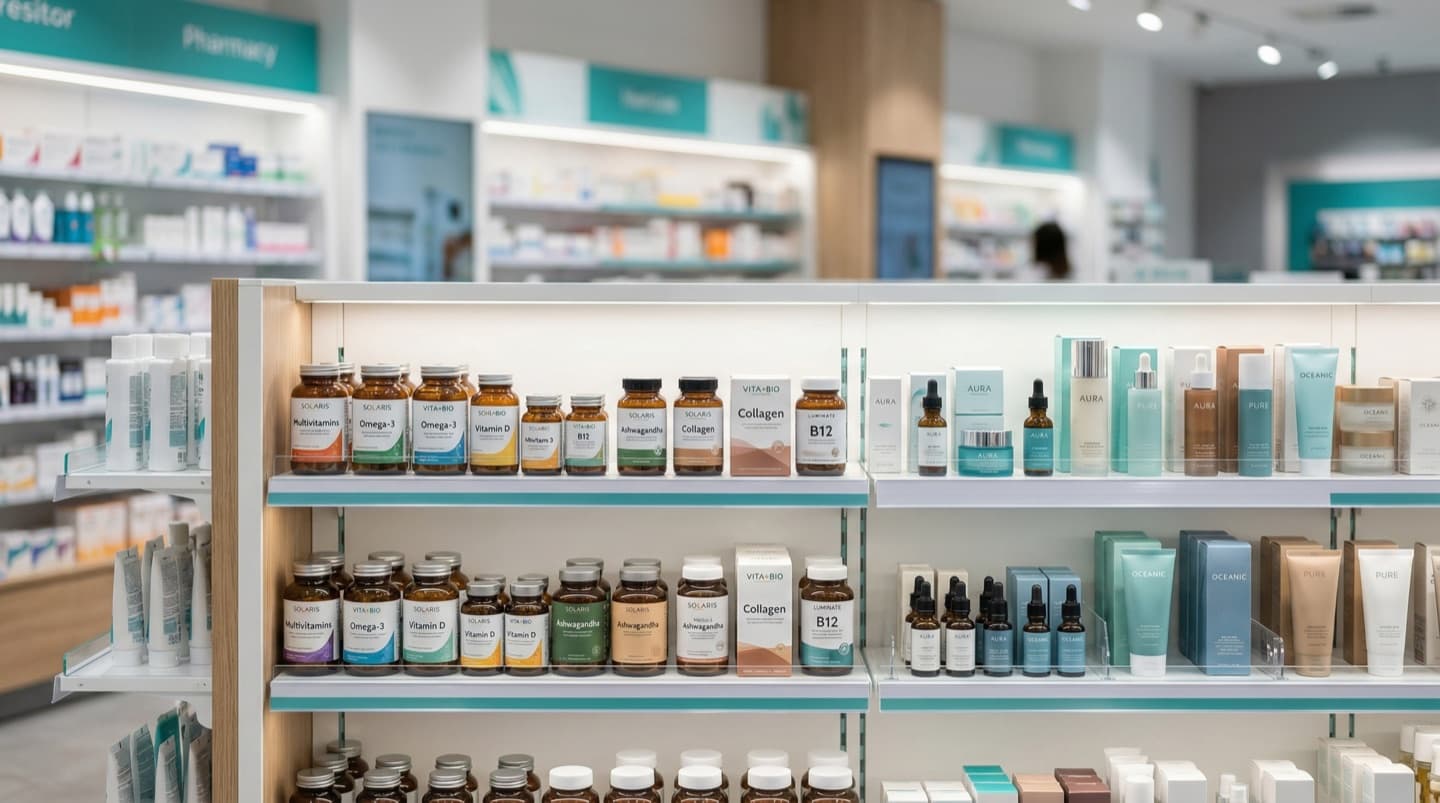
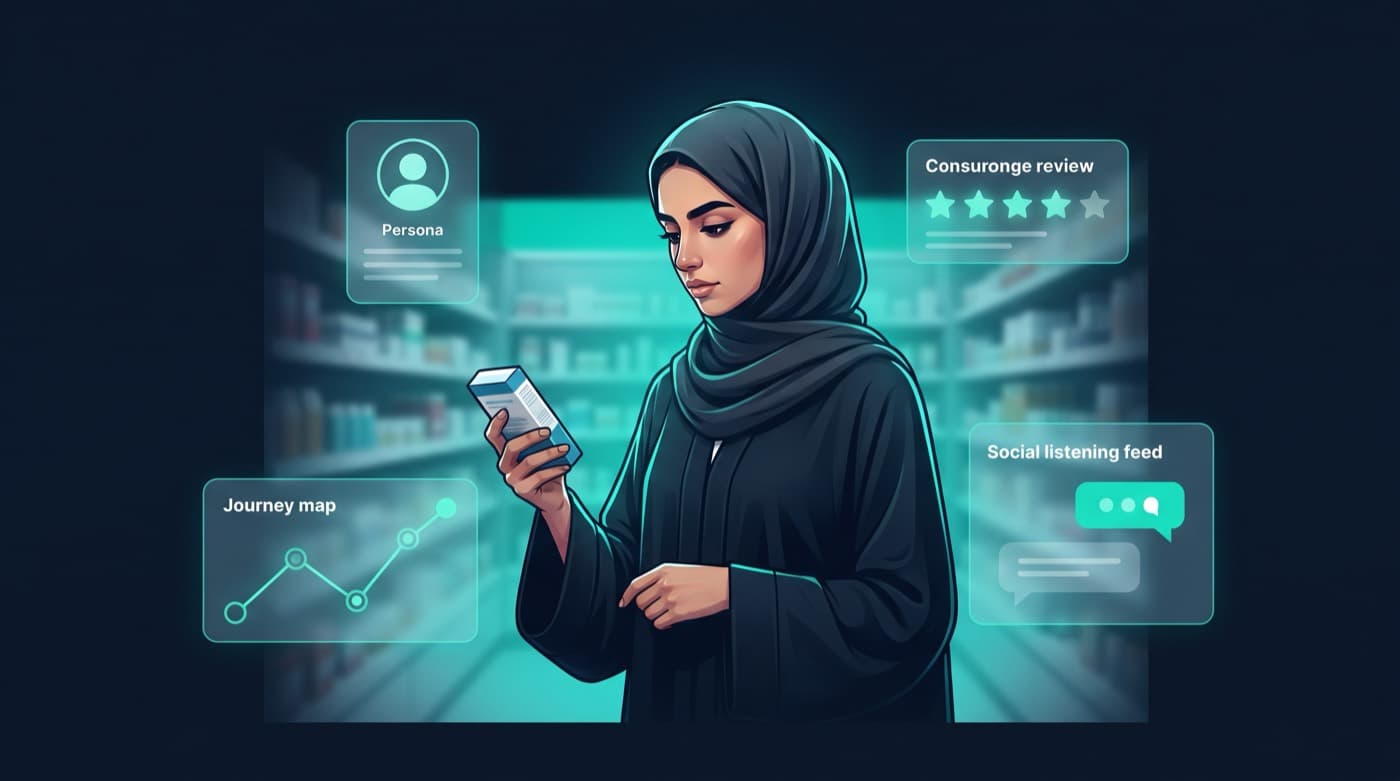
Here is the short answer, up front. To actually understand your shopper in Saudi Arabia you need three things: direct contact with real consumers instead of pharmacist proxies, a jobs-to-be-done lens that reveals why people really buy health products, and an always-on set of cheap listening methods — review mining, Arabic social listening, pharmacy staff interviews, WhatsApp communities, and in-home observation. None of this requires a six-figure research budget. It requires discipline and a willingness to hear things your brand plan does not want to hear.
I have spent more than 20 years in consumer healthcare and pharmaceutical marketing across Saudi Arabia and the GCC, working on more than 80 CHC brands — from analgesics and vitamins to dermo-cosmetics and baby care. In that time I have reviewed hundreds of brand plans. I can count on one hand the ones that quoted a real shopper saying something in her own words. That gap — between the consumer on the slide and the consumer in the pharmacy aisle — is the single biggest source of wasted marketing money in this industry. This article is the playbook I use to close it.
~63%
Of Saudi Arabia's population is under 35 — your shopper is younger than your brand plan assumes
8 in 10
KSA health shoppers research online before buying — TikTok, Google, and increasingly AI assistants
5–10x
Cheaper to mine existing reviews and social conversations than to commission a traditional U&A study
0
Real shopper verbatims in the average CHC brand plan I review — the gap this article exists to fix
Why Do Consumer Healthcare Brands Fail at Consumer Understanding?
Because most CHC organizations in this region are pharmaceutical companies wearing a consumer hat. Their commercial model was built for prescription medicine: call on doctors, detail pharmacists, negotiate with distributors, win the recommendation. That model works brilliantly for Rx. It fails quietly for consumer healthcare, because the person who decides, pays, and swallows is not in any of those meetings.
Think about who a typical CHC brand manager in Riyadh or Jeddah actually talks to in a normal month: the medical rep team, the key account manager for Nahdi and Al-Dawaa, the distributor, maybe a few pharmacists on a field visit. All valuable. All proxies. The pharmacist tells you what shoppers ask for at the counter — which is the end of the journey, stripped of everything that happened before: the 11pm TikTok scroll, the Google search in Arabic, the question typed into an AI assistant, the WhatsApp message to a sister asking what she used for her kids.
The failure shows up in predictable symptoms. If you recognize more than two of these in your own organization, this article is for you:
- Brand plans that describe the consumer in demographics only — “females 25–45, AB social class” — with no situation, motivation, or verbatim
- Campaigns built on the product’s ingredient story rather than the shopper’s problem
- Global segmentation decks applied to KSA without a single local validation study
- Research that happens once every two or three years, usually to justify a decision already made
- Teams that can recite pharmacist objections from memory but cannot describe a single real shopper’s morning routine
- Surprise when a competitor — often a digital-native local brand — wins on a positioning “we never saw coming”
The uncomfortable truth: the pharmacist is a channel, not a consumer. The doctor is an influencer, not a consumer. The distributor is logistics, not a consumer. Until your team spends real time with the actual human being who opens the pack at home, you are running a consumer business on secondhand information.
The same discipline applies to the supply side of insight: consumer understanding tells you what shoppers want, but you also need to see what the market is doing. RaqibHealth tracks new SFDA registrations, competitor launches, and recalls across KSA and the GCC — the market-movement half of the intelligence picture that pairs with the consumer half this guide covers.
Who Is the KSA Consumer Healthcare Shopper of 2026?
She is younger, more digital, and dramatically better informed than the shopper most brand plans were written for. Roughly two-thirds of the Saudi population is under 35. This is a generation that grew up with a smartphone, expects same-day delivery from Nahdi Online and Amazon.sa, and treats health information as something you pull, not something you receive.
The research behavior is the biggest shift. In 2016, the journey for an OTC purchase was short: feel a symptom, go to the pharmacy, ask the pharmacist, take what he hands you. In 2026, by the time your shopper reaches the shelf or the app, she has often already decided. She watched three TikTok videos about magnesium for sleep. She Googled the difference between melatonin and valerian in Arabic. She asked an AI assistant whether a supplement is safe with her medication — and got a structured, confident answer in seconds. The pharmacist is no longer the first source of health information. He is the last checkpoint.
This is exactly why I keep telling brand teams that content is now a core part of the brand’s job, not a nice-to-have — I covered the channel side of this in how to build a pharmaceutical brand on social media in Saudi Arabia. If your brand is absent from the research phase, you are competing only at the shelf, with a shopper whose mind is already made up.
| Dimension | KSA CHC Shopper, 2016 | KSA CHC Shopper, 2026 |
|---|---|---|
| First health information source | Pharmacist or family elder | TikTok, Google (Arabic), AI assistants |
| Role of the pharmacist | Primary advisor and decision-maker | Final checkpoint and availability point |
| Purchase channels | Physical pharmacy, almost exclusively | Pharmacy + Nahdi Online, Amazon.sa, Noon, quick-commerce apps |
| Attitude to prevention | Treat when sick | Supplements, self-care routines, wearables, fitness culture |
| Trust signals | Doctor’s word, brand heritage | Reviews, ratings, influencer credibility, ingredient literacy |
| Language of research | Mostly offline conversation | Arabic-first search and social, English for deep dives |
| Price behavior | Accepts pharmacy shelf price | Compares across apps in seconds, waits for White Friday deals |
| Loyalty driver | Habit and pharmacist repetition | Experience, results, community validation, subscription convenience |
Two more KSA-specific realities matter here. First, seasonality is cultural as much as climatic: Ramadan reshapes energy, digestion, and sleep categories for two months every year, Hajj creates a travel-health spike, and back-to-school drives immunity and vitamins. Second, the female shopper controls far more of the category than most share-of-voice plans reflect — she is the household’s health decision-maker, buying for herself, her children, and frequently her parents. If your insight work does not deliberately reach her, it is not insight work.
What Is Jobs-to-Be-Done — and Why Does It Change Everything in Health Categories?
Jobs-to-be-done (JTBD) is the most useful consumer framework I have applied in 20 years of CHC marketing, and it fits health categories almost perfectly. The definition worth memorizing:
Consumers do not buy products; they hire them to make progress in a specific situation. The “job” is the progress the person is trying to make — functional, emotional, and social at the same time. When a better way to get the job done appears, the consumer fires the old solution without sentiment.
Why does this matter so much in consumer healthcare? Because in health categories, the stated purpose on the pack and the real job in the shopper’s life are frequently different things — and the gap is where positioning either connects or dies. Two examples I have seen play out repeatedly in the KSA market:
The sleep aid that is really an anxiety product. On the label, melatonin is about falling asleep. Mine the reviews and listen to the conversations and you find something else: people describing racing thoughts, work stress, doom-scrolling at 1am, waking up at 3am with their mind spinning. A large share of sleep aid purchases in KSA are hired to quiet an anxious mind, not to fix a circadian problem. The brand that talks about “switching off the day” connects with the real job. The brand that talks about sleep architecture and receptor science is answering a question nobody asked.
The multivitamin that is really a guilt-relief product. Nobody wakes up craving micronutrients. The multivitamin is hired to relieve the low-grade guilt of a fast-food week, skipped gym sessions, and a diet the shopper knows is not what it should be. It is a daily act of self-care and self-forgiveness — one small ritual that says “I am looking after myself.” The mother buying kids’ gummies is hiring reassurance that she is a good mother even when dinner was delivery again. Market the nutrient panel and you are invisible. Market the feeling of being back in control, and you win the category.
| Category | What the Label Says | The Job Actually Hired For | What This Changes in Marketing |
|---|---|---|---|
| Sleep aids (melatonin, herbal) | Helps you fall asleep | Quiet an anxious mind at the end of a stressful day | Message calm and switching off, not sleep mechanics |
| Multivitamins | Fills nutritional gaps | Relieve diet guilt; a daily self-care ritual | Sell the feeling of control, not the ingredient list |
| Kids’ vitamins & gummies | Supports child growth and immunity | Reassure the mother she is doing right by her children | Speak to her standards, never to her fears |
| Pain relief (fast formats) | Relieves headache and body pain | Stay functional through work and family obligations | Position around not losing the day, not pain scores |
| Probiotics & digestive health | Supports gut flora balance | Eat social meals without paying for them later | Anchor to occasions (gatherings, Ramadan) not biology |
| Dermo-cosmetics (anti-aging) | Reduces appearance of fine lines | Feel confident on camera and in high-social-scrutiny settings | Talk about how she shows up, not about molecules |
The practical discipline: for every brand you manage, write down the label promise in one column and the hired job in the other. If both columns say the same thing, you have not done the work yet. The hired job is discovered, not deduced — which brings us to how you actually discover it without a research department.
Which Cheap Insight Methods Actually Work in the GCC?
Here is my strong opinion, formed the expensive way: for most CHC brands in this region, a 300,000-riyal usage-and-attitude study is the worst first purchase you can make. It arrives six months late, describes averages rather than people, and gets skimmed once before dying in a SharePoint folder. The methods below cost a fraction of that, can start this week, and — run consistently — build a sharper picture of your shopper than any single big study.
1. Ratings and Reviews Mining on Amazon.sa and Nahdi Online
This is the single highest-value insight source available to a CHC brand in KSA today, and it is free. Thousands of shoppers have already written down — in their own words, in Arabic and English — why they bought, what they hoped for, what disappointed them, and what they will do next. Nobody paid them, nobody led them with a questionnaire, and they were describing real usage, not hypothetical intent.
The method is simple. Pull every review for your brand and your top three competitors from Amazon.sa and Nahdi Online — and Noon if the category trades there. Read all of them; do not sample. Tag each review against four questions: What triggered the purchase? What job was the product hired for? What did success look like? What caused disappointment? Patterns emerge fast — usually within 200–300 reviews you will find two or three jobs nobody on your team had articulated. I walked through the commercial side of these platforms in the state of consumer healthcare e-commerce in the GCC; the insight side is just as valuable as the sales side.
- Read Arabic reviews in Arabic — machine translation flattens exactly the emotional language you are looking for
- One-star and two-star reviews are worth double: they tell you the job the product failed to do
- Mine competitor reviews harder than your own — their disappointed customers are your acquisition brief
- Repeat monthly; reviews are a moving signal, not an archive
2. Arabic Social Listening on TikTok, X, and Snapchat
Saudi Arabia has some of the highest social media engagement rates in the world, and health is one of the most discussed topics. But most “social listening” in this market fails for one reason: it is run in English, with global tools, against a conversation happening in Arabic — often in dialect, with category slang the tools do not recognize.
Do it manually first. Have an Arabic-speaking team member spend two hours a week searching TikTok and X for the category terms real people use — not your brand’s clinical vocabulary. Search “ما اقدر انام” (I can’t sleep), not “insomnia solutions.” Capture screenshots, note the questions people ask under influencer videos, and log the home remedies and rituals people mention — because your real competitor is often chamomile tea and grandmother’s advice, not the brand next to you on the shelf. Comments sections are the gold: that is where the audience corrects the influencer and tells you what actually happened when they tried the product.
3. Pharmacy Staff Interviews — Done Properly
I spent the first section of this article warning against treating pharmacists as consumer proxies, so let me be precise about what pharmacy staff interviews are for. The counter staff cannot tell you why shoppers buy — but they are an unmatched source on three specific things: the exact words shoppers use when they ask, the objections and hesitations at the moment of purchase, and what shoppers do when the preferred product is out of stock.
Structure matters. Do not send a rep with a questionnaire — the answers will be polite and useless. Sit with counter staff at quiet hours, ask for stories, and dig for verbatims: “Tell me about the last woman who asked about sleep products. What exactly did she say? What did she ask when you recommended something? Did she buy it?” Ten conversations like this across different neighborhoods and store formats will give you the shelf-moment picture that reviews and social listening cannot.
4. WhatsApp Community Polls
WhatsApp is the default communication layer of the Gulf, and it is criminally underused as a research channel. Build a small community — 30 to 80 category-relevant consumers recruited through your CRM, in-store QR codes, or an agency panel — and treat it as an always-on insight group. Short polls, photo tasks (“show me where you keep your vitamins”), quick voice-note questions. Response rates embarrass every other methodology because you are meeting people inside an app they open fifty times a day.
- Keep tasks under two minutes; this is a conversation, not a survey
- Photo and voice tasks reveal more than text — the medicine drawer photo is an insight goldmine
- Incentivize lightly and consistently (vouchers work well in KSA)
- Respect privacy scrupulously: consent, anonymized reporting, easy exit — health is sensitive data
5. In-Home Usage Observation
The most powerful method on this list, and the least used. Five to eight home visits, watching how real households store, dose, share, and forget your category, will destroy more internal myths than any deck. In-home work in KSA needs cultural care — female researchers for female households, family consent, respect for privacy norms — and a good local qualitative moderator handles all of this routinely.
What you learn in homes is what nobody reports in surveys: the vitamins bought with conviction in January sitting unfinished in March; the single pack of pain relief shared across three generations; the children’s syrup dosed by memory rather than by the cup; the supplement taken only when a friend mentions hers. Compliance, sharing, and abandonment are where CHC volume is truly won and lost — and they are invisible from the shelf.
| Method | Typical Cost | Time to First Insight | Best For | Watch Out For |
|---|---|---|---|---|
| Reviews mining (Amazon.sa, Nahdi Online) | Free — internal time only | Days | Real jobs, disappointments, competitor weaknesses | Skews to online shoppers; read Arabic natively |
| Arabic social listening | Low — manual first, tools later | 1–2 weeks | Category language, triggers, home-remedy competitors | English-only tools miss the real conversation |
| Pharmacy staff interviews | Low — field time | 1–2 weeks | Shelf-moment words, objections, out-of-stock behavior | A proxy for the counter only — not for motivation |
| WhatsApp community polls | Low — incentives + moderation | Continuous | Fast reads, photo tasks, concept reactions | Small samples; direction, not measurement |
| In-home usage observation | Moderate — moderator + incentives | 3–4 weeks | Compliance, storage, sharing, abandonment truths | Needs cultural sensitivity and skilled moderation |
| Traditional U&A study | High — agency fees | 4–6 months | Category sizing and tracking at scale | Averages, lag, and a deck nobody rereads |
Insight Economics
Insight Value per Riyal Spent — GCC CHC Research Methods
Value-per-riyal score out of 10 — based on my experience deploying each method across CHC brands in KSA and the GCC. U&A studies have their place for sizing and tracking, but as a first insight investment they are poor value.
How Do You Build Personas and Need-States for a CHC Category?
Two definitions first, because these words get abused in marketing departments:
A consumer persona is a decision-making tool, not a character sketch. It is a composite of a real segment of shoppers, defined by their situation, motivation, and behavior — built so that a brand team can predict how that segment will respond to a message, a format, a price, or a channel. If a persona cannot change a decision, it is decoration.
A need-state is the combination of situation, motivation, and desired outcome that drives a specific purchase occasion. People move between need-states; personas describe people, need-states describe moments. In consumer healthcare, need-states are usually the more powerful planning unit, because the same woman buys the same category differently in different moments of her life.
Let me make this concrete with a worked example from a category I know well: sleep support in KSA. Run the methods from the previous section — reviews, social listening, pharmacy conversations, a WhatsApp community — and the category resolves into four distinct need-states:
| Need-State | Trigger Situation | Job Hired For | What Wins This Moment |
|---|---|---|---|
| “Tonight, please” — acute crisis | Two or three bad nights before an exam, presentation, or event | Guarantee sleep tonight, no experimentation | Fast-acting claims, pharmacist endorsement, single-night trust |
| “Quiet the mind” — anxiety-driven | Chronic work stress, racing thoughts, 3am waking | Switch off mental noise at the end of the day | Calm positioning, gentle/natural cues, ritual formats |
| “Ritual builder” — self-care routine | Wellness-oriented consumer optimizing sleep quality | Upgrade sleep as part of a health identity | Ingredient literacy (magnesium, glycine), stacks, content depth |
| “Reset” — disrupted rhythm | Travel, Ramadan schedule inversion, shift work | Recover a normal rhythm quickly | Occasion-based messaging, melatonin timing guidance, travel formats |
Notice what this table does that a demographic segmentation cannot: each row implies a different message, a different format priority, a different channel moment, and a different competitor set. The “Reset” need-state competes with nothing during ten months of the year and with everything during Ramadan. The “Ritual builder” is won on TikTok and lost in ingredient-free advertising. One category, four different marketing problems.
From need-states, build personas — one per dominant need-state. Here is what a usable one looks like, drawn from the “Quiet the mind” state:
- Noura, 29, Riyadh. Marketing manager at a Saudi company scaling fast under Vision 2030 pressure; she loves the career and pays for it in sleep
- Situation: In bed by 11:30, mind racing until 1:30; wakes at 3am rehearsing tomorrow’s meetings two or three nights a week
- Job to be done: End the day — switch off the mental noise without feeling drugged tomorrow
- Research behavior: TikTok first, then Arabic Google, then asks an AI assistant to compare ingredients and check safety; reads Amazon.sa reviews before any purchase
- Purchase behavior: Buys on the Nahdi app at midnight for next-day delivery; will not ask a pharmacist about sleep face-to-face — it feels like admitting something
- Barriers: Fear of dependency, fear of morning grogginess, quiet worry about what taking “sleeping pills” says about her
- What wins her: A brand that names the racing-mind experience precisely, feels gentle and modern, and shows her people like her — not clinical insomnia imagery
Every line of that persona is actionable, and every line came from a cheap method: the 3am waking language from reviews, the AI-assistant step from the WhatsApp community, the embarrassment barrier from pharmacy staff interviews. That is the standard: personas assembled from evidence, not written from imagination in a workshop.
What Does the KSA Consumer Journey Actually Look Like, from Trigger to Repeat?
A journey map is only useful if it is drawn from the shopper’s side of the counter. Here is the generalized CHC journey I map against in KSA, with the questions the shopper is asking at each stage — because the brand’s job at every stage is to be the best answer to that stage’s question.
- Trigger. A symptom, a life event, a piece of content, or a person. The trigger is rarely the category — it is a moment: the third bad night, the child’s new school term, a friend’s transformation story, a TikTok that names a problem she had not named herself. Brands that understand triggers can create them; brands that do not can only wait for them.
- Research. TikTok, Arabic Google, AI assistants, review sections, and the family WhatsApp group — usually in that order, usually within 48 hours of the trigger. This stage now decides most purchases. Being absent here means competing only on availability and price later.
- Shelf or PDP. The physical shelf at Nahdi or Al-Dawaa, or the product detail page on the app. Different rules, same function: confirm the decision, or break it. At the shelf, navigation and adjacency do the work — I covered that world in merchandising for consumer healthcare brands. On the PDP, images, Arabic content quality, ratings count, and delivery promise do the same job.
- Purchase. Increasingly split between planned online replenishment and impulse or urgency-driven offline. Price comparison happens in seconds across apps; out-of-stock at this moment does not delay the sale — it donates it to a competitor, and reviews mining shows switchers often do not come back.
- Usage. The forgotten stage, and the one that decides everything after it. Does the product get used correctly, consistently, at all? Half-finished packs do not repeat. The brands that support usage — reminders, realistic expectations, WhatsApp follow-up content, clear Arabic dosing guidance — convert one purchase into a habit.
- Repeat and advocacy. Repeat is earned in the usage stage and harvested here: subscription options, replenishment nudges, loyalty integration with pharmacy apps. Advocacy in KSA is disproportionately private — the family WhatsApp group recommendation moves more units than most paid campaigns, and it cannot be bought, only deserved.
The audit I run with brand teams is simple: for your brand, write down what the shopper finds at each of these six stages. Most CHC brands in this market discover they are investing 80% of their budget at stages 3 and 4 — shelf and purchase — while the decision is being made at stage 2 and the repeat is being lost at stage 5. The money is not wrong; it is early-2010s right.
How Do You Turn an Insight Into a Brief?
Insight that never changes a brief is entertainment. Here is the discipline I hold teams to. First, the definition:
A real consumer insight has three parts: a tension the consumer feels, the underlying cause of that tension, and the opportunity it creates for the brand. If any of the three is missing, you have an observation, not an insight. “Consumers want to sleep better” is an observation. An insight sounds like this: “Young professional women in KSA lie awake rehearsing tomorrow because ambition does not come with an off switch (tension), they will not seek help face-to-face because sleep struggles feel like weakness (cause), so the brand that lets them solve it privately, gently, and without judgment wins the moment no one else can reach (opportunity).”
From insight to brief, three rules:
- The insight leads the brief, verbatim. Page one, in the consumer’s own words wherever possible. If the agency never sees the verbatims, they will invent a consumer — and agencies invent flattering consumers
- One insight per brief. A brief built on three insights is built on none. Pick the tension this campaign resolves and park the rest for the next brief
- Brief the job, not the product. The brief should demand work that helps Noura switch off her day — not work that showcases the molecule. The product earns its place by serving the job
Before and after, from a real (disguised) case: the original brief for a sleep supplement read, “Communicate our clinically supported dual-action formula to females 25–45 to drive awareness and trial.” The rebuilt brief read, “Show the woman whose mind will not stop at 1am that we understand that exact moment — and that switching off is allowed.” Same product, same budget, same media plan. The second campaign tripled the engagement rate of the first and, more importantly, showed up in reviews: shoppers started using the campaign’s language to describe the product. When consumers repeat your words back in their reviews, the insight loop has closed.
What Are the Most Common Consumer Insight Mistakes in CHC?
I have made several of these myself, which is how I know how expensive they are. In rough order of the damage they cause:
- Demographics-only personas. “Female, 25–45, urban, middle income” describes roughly four million Saudi women who have almost nothing in common at the moment of purchase. Demographics tell you who could buy; need-states tell you why they do. If your persona would survive being read aloud in a competitor’s meeting without anyone noticing it is not theirs, it is not a persona.
- Importing global segmentations into KSA. The global team’s six-segment model was built on European and American data. It does not know Ramadan reshapes half your categories for two months. It does not know the family WhatsApp group outranks every influencer. It does not know the pharmacist conversation is a male-dominated space many female shoppers quietly route around. Validate locally or start locally — but never paste globally.
- One-off research instead of always-on listening.A study is a photograph; this market is a video. The KSA consumer healthcare shopper changed more between 2020 and 2026 than in the two decades before. If your consumer understanding has a fieldwork date more than a year old, you are marketing to someone who no longer exists.
- Confusing what shoppers say with why they buy.In surveys, everyone buys vitamins for “health and immunity” and chooses brands on “quality.” In homes and reviews, they buy for guilt, ritual, and reassurance, and choose on packaging, price anchors, and a cousin’s recommendation. Claimed behavior is what the consumer thinks she should say; observed behavior is where the money is.
- Researching only your own users. Your buyers can tell you why you win; only non-buyers, rejectors, and lapsed users can tell you why you are small. Mine competitor reviews, talk to the shopper who picked the product next to yours, and ask the pharmacy staff what people who refuse your brand actually say.
- Treating the pharmacist recommendation as consumer understanding. The recommendation is an outcome you buy with detailing and trade terms; it tells you about your channel execution, not your consumer. When a digital-native brand with zero pharmacist equity takes share — and in KSA this now happens every year — the brands that only ever listened at the counter never see it coming.
What Does an Always-On Insight Rhythm Look Like in Practice?
To make the always-on principle concrete, here is the operating rhythm I install with CHC brand teams in KSA. It costs a fraction of one traditional study per year and fits inside a normal brand team’s calendar:
- Monthly (half a day): Pull new reviews from Amazon.sa and Nahdi Online for your brand and key competitors; two hours of Arabic social listening; log new verbatims into a shared insight file the whole team can search
- Quarterly (two field days): Ten pharmacy staff conversations across neighborhoods and formats; one WhatsApp community deep-dive task (photo or voice); update the need-state map with anything that moved
- Twice a year (one week): Five to eight in-home visits or shopper journey interviews; pressure-test every live persona against fresh evidence and retire anything the data no longer supports
- Annually (one planning session): Rewrite the insight page of every brand plan from the year’s accumulated verbatims — and only then decide whether a large quantitative study is worth commissioning, and for which specific question
The shared insight file is the quiet hero of this system. One document — verbatims, screenshots, review quotes, tagged by need-state — that every brief, every agency onboarding, and every new team member starts from. Within a year it becomes the most consulted document in the marketing department, and the cheapest competitive advantage you own, because no competitor can copy what they never hear.
Key Takeaways
- The pharmacist, the doctor, and the distributor are proxies — consumer understanding starts when you reach the person who opens the pack at home
- The KSA shopper of 2026 is young, Arabic-first, and researches on TikTok, Google, and AI assistants before ever reaching the shelf — the pharmacy is the last checkpoint, not the first source
- Jobs-to-be-done reveals the real purchase driver: sleep aids hired to quiet anxiety, vitamins hired to relieve guilt — market the job, not the label
- Five cheap methods beat one expensive study: review mining on Amazon.sa and Nahdi Online, Arabic social listening, pharmacy staff interviews, WhatsApp communities, and in-home observation
- Build personas from need-states and evidence, never from demographics and imagination — if it cannot change a decision, it is not a persona
- Map the journey from trigger to repeat and fund the stages where decisions actually happen — research and usage, not just shelf and purchase
- An insight is a tension, a cause, and an opportunity — and it belongs verbatim on page one of every brief
- Make listening always-on: monthly reviews and social, quarterly pharmacy conversations, a continuous WhatsApp community, annual deep qualitative
What to Do Next
Do not commission anything yet. This week, pull every review of your biggest brand and its two closest competitors from Amazon.sa and Nahdi Online, and read them all — personally, not summarized by an agency or an AI. Tag the triggers, the jobs, and the disappointments. Then write one page: the three things these shoppers are telling us that our current brand plan does not know. That single exercise costs nothing and will justify every further step in this article.
Then build the rhythm: social listening into your monthly review, pharmacy conversations into next quarter’s field plan, a WhatsApp community before year-end. Feed what you learn into your digital and content engine — the channel playbook for that is in digital marketing for pharmaceutical companies.
After more than 20 years and 80-plus consumer healthcare brands in Saudi Arabia and the GCC, the pattern is absolute: the brands that win this market are not the ones with the biggest budgets or the deepest pharmacist relationships. They are the ones that know their shopper so precisely that every message, pack, and shelf decision feels — to her — like the brand read her mind. That precision is not bought. It is built, method by cheap method, by teams disciplined enough to keep listening after everyone else has gone back to their dashboards.