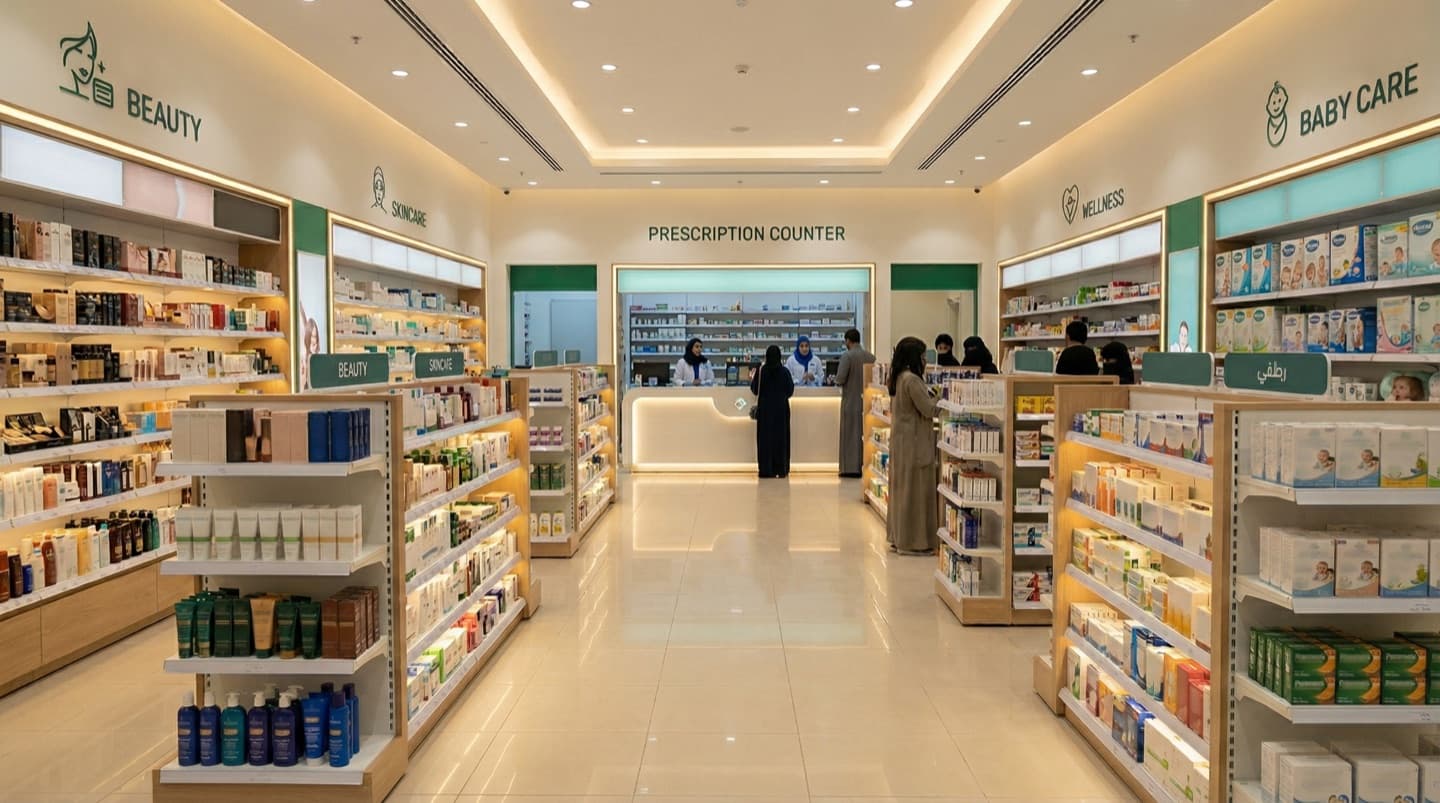

Launching an OTC product in Saudi Arabia takes 12 to 18 months and is won or lost in six phases: assess the opportunity before you commit (category size, competitors, price corridor, private-label threat); secure the right SFDA classification, because it decides your timeline and your claims; choose your route to market and negotiate trade terms with eyes open; build the launch mix around pharmacist recommendation, with e-commerce ready on day one; execute at the shelf; and manage the first 90 days on a sell-out scorecard, not a sell-in celebration. This playbook walks through each phase in order, with the timelines, fee structures, and budget splits I actually use.
Over twenty years in Saudi Arabia and the GCC I have launched or managed more than eighty consumer healthcare brands — OTC medicines, supplements, dermo-cosmetics, oral care, baby care. Some of those launches beat their year-one target by half again. Others limped. The difference was almost never the product. It was the sequence and the discipline described below.
Why Do Most OTC Launches in Saudi Arabia Miss Their Year-One Targets?
Because most launch plans are written backwards. They start with the marketing campaign and work back to the shelf, when the Saudi market punishes exactly that order. In KSA, an OTC launch is a supply-side and counter-side game first: if your registration classification is wrong, nothing else matters; if your distributor cannot build weighted distribution fast, your media spend advertises your competitor’s shelf; and if the pharmacist has never heard of you, the consumer who walks in asking “what should I take for this?” will walk out with someone else’s brand.
Here is the definition I hold every launch plan to: a successful OTC launch in Saudi Arabia is one where, within 90 days, the product is available in the doors that matter, recommended by the pharmacists who staff them, findable and buyable online, and selling out at a rate that justifies the trade investment — measured weekly, at sell-out level. Everything in this playbook exists to make that sentence true.
The phases below are numbered 0 to 5 deliberately. Phase 0 is the one most companies skip, and skipping it is the most expensive mistake on this list.
Phase 0: Is This Category Worth Entering? The Opportunity Assessment
Before a single riyal goes into registration or trade terms, four questions need honest answers. I have seen companies spend eighteen months and seven figures launching into categories they should have walked away from in week two of the assessment.
How big is the category — really?
Size the category at three levels: total KSA value (IQVIA or Nielsen data where available, retail audit proxies where not), the addressable segment your product actually competes in, and the realistic share a new entrant can take in years one to three. The trap is sizing at the first level and building the business case on it. A “SAR 400 million category” often contains a SAR 60 million addressable segment once you strip out prescription-leaning subsegments, formats you do not offer, and price tiers you cannot reach.
- Value and volume trend: Is the category growing in units, or only in price? Price-driven growth is fragile in a market where private label is expanding.
- Seasonality: Cough-cold, allergy, and sun care categories in KSA have sharp seasonal windows. Your launch month must respect them — launching a cough-cold brand in March means paying twelve months of trade fees before your first real season.
- Channel split: What share sits in pharmacy versus grocery versus e-commerce? This determines your route-to-market cost later.
Who will you be taking share from?
New OTC categories are rare. In practice you are taking share from named competitors, and you should be able to name them before launch. Map the top five brands in the segment on four dimensions: price, claim platform, share of pharmacist recommendation, and trade investment intensity. The last one is the most overlooked. A competitor with modest media but deep trade programs — strong planogram positions, embedded pharmacist relationships, aggressive promo calendars — is far harder to displace than a heavy advertiser with shallow retail roots.
The hardest competitor to plan against is the one you never saw coming — a rival product that registers with the SFDA while you are still building your own dossier. This is exactly what RaqibHealth was built to catch: it tracks new SFDA registrations, approvals, and recalls across KSA and the GCC, so competitor launches show up as an early-warning signal instead of a shelf-day surprise.
Where is the price corridor?
The price corridor is the range between the cheapest credible competitor and the most expensive brand that still sells in volume — the band within which a new entrant can price without either destroying its margin structure or pricing itself out of pharmacist recommendation. Find it empirically: shelf-check the top twenty doors, pull e-pharmacy prices, and note promo depth, because the effective price consumers pay in KSA is often 15 to 25 percent below the shelf price once chain promotions are counted.
Then stress-test your landed cost against it. By the time you stack cost of goods, freight, customs, distributor margin, retailer margin, listing fees, and promo funding, many imported OTC products cannot live inside the corridor at all. Better to learn that in Phase 0 than at the Nahdi negotiation table.
What is the private-label threat?
Nahdi and Al-Dawaa both run serious private-label programs, and they are strongest in exactly the categories that attract new OTC entrants: vitamins, supplements, skin care, first aid, basic analgesics. Ask two questions. First, does the chain already have a private-label SKU in your segment? If yes, expect your listing negotiation to be harder and your shelf position worse — you are negotiating with a competitor. Second, if your launch succeeds, how quickly could the chain copy it? A product whose only differentiation is price and format is a private-label brief waiting to be written. Products defended by brand equity, clinical evidence, unique ingredients, or strong pharmacist advocacy are much harder to copy profitably.
If the category is big enough, the corridor is livable, the competitors are beatable, and the private-label response is survivable, move to Phase 1. If two or more of those are shaky, stop. The cheapest launch decision is the one made before registration.
Phase 1: Which SFDA Pathway Fits Your Product — and Why It Decides Everything
This is the phase where launches are quietly won or lost a year before the launch event. In Saudi Arabia, the SFDA classification of your product — pharmaceutical OTC, food supplement, or cosmetic — determines your registration timeline, the claims you may make, whether your price is set for you, and which channels you can sell through. The same formulation can sometimes plausibly qualify under more than one pathway, which makes classification a genuine strategic decision. Take it early, take it deliberately, and take regulatory advice before you commit the business case.
| Dimension | Pharmaceutical OTC | Food Supplement | Cosmetic |
|---|---|---|---|
| Pathway | Full SFDA drug registration (dossier, review, approval) | SFDA notification/registration via the food-supplement route | SFDA cosmetic notification (eCosma system) |
| Realistic timeline | 9–18 months in practice; reliance and verification pathways can shorten it for products approved by reference regulators | 3–6 months in most cases | Weeks to ~3 months |
| Claims allowed | Therapeutic claims per the approved indication and label | Structure-function and nutritional claims only; no treatment or cure language | Appearance and cosmetic-benefit claims only |
| Pricing | SFDA-approved public price; pricing file is part of registration and constrains your corridor position | Free pricing | Free pricing |
| Channels | Pharmacy only | Pharmacy plus grocery and broader retail, depending on product | Widest: pharmacy, grocery, beauty retail, e-commerce |
| Marketing constraints | Strictest: advertising of medicines is tightly controlled and pre-approval applies | Moderate: claims discipline required, influencer content included | Lightest, but claims must stay cosmetic |
Three practical implications I insist on in every launch plan:
- Classification before business case. A product modeled as a supplement that SFDA later treats as a drug loses a year of timeline and its claims platform in one meeting. Get a formal or informal classification read before you lock the P&L.
- For pharmaceutical OTC, respect the pricing file.The SFDA-approved public price anchors your entire corridor position, and it references prices in other markets. If your international pricing is inconsistent, fix that before submission — it is nearly impossible to fix after.
- Claims are a regulatory asset, not a copywriting exercise. Whatever pathway you choose, the approved claims become the ceiling of your claim ladder in Phase 3. Choose the pathway that gives you the claims your positioning actually needs.
Everything you say in market — packaging, POSM, social content, influencer briefs, e-commerce product pages — must stay inside the approved claims for your classification. I cover the rules, approval flows, and the mistakes that trigger enforcement in my guide to SFDA marketing compliance, which I would treat as required reading before any creative development starts.
Phase 2: How Should You Go to Market — Direct or Through a Distributor?
Unless you establish a licensed Saudi entity, you will need a local importer and distributor of record. That part is not optional. What is optional — and strategic — is how much of the demand-creation work you hand over with the box-moving work. The biggest route-to-market mistake I see is treating the distributor decision as a logistics decision, when it is really a decision about who owns your brand’s relationships with Nahdi, Al-Dawaa, and the pharmacists behind their counters.
Direct presence vs. distributor: the honest comparison
| Dimension | Direct (own entity / scientific office) | Distributor-led |
|---|---|---|
| Speed to market | Slow: entity setup, licensing, hiring add 12+ months | Fast: infrastructure already exists |
| Margin conceded | None to a partner, but full fixed-cost base is yours | Typically 25–35% of the trade price depending on services included |
| Control of execution | Full control of key accounts, field force, activation | Shared at best; your brand is one of many in the distributor’s bag |
| Credit and collection risk | Yours | Distributor’s — a real and underrated benefit in this market |
| Registration holder | Your entity | Usually the distributor — negotiate transferability up front |
| Best fit | Portfolios with scale, or companies committed to KSA long term | Single-brand launches, market tests, and most first entries |
For most first launches the practical answer is a hybrid: distributor for import, warehousing, invoicing, and coverage; your own (even small) commercial team for key account management, pharmacist engagement, and marketing. The worst-performing model in my experience is full delegation — handing the distributor the brand plan and expecting launch-quality execution across their entire portfolio of principals. It does not happen. Distributor sales reps are volume-incentivized generalists; your launch needs missionaries.
What should you look for in a distributor?
- Actual coverage, not claimed coverage: Ask for their active customer list by region and channel. Many distributors are strong in Riyadh and Jeddah and thin in the Eastern Province, the North, and independent pharmacies.
- Category credibility: A distributor respected in consumer healthcare gets better listing terms and better planogram outcomes than a generalist, because the chains trust their category input.
- Data transparency: Contractually secure sell-through data by account, monthly at minimum, weekly during launch. Without it you will manage the launch blind.
- Principal load: How many brands does each rep carry? If the answer is forty, your launch will get ninety seconds per pharmacy visit.
- Trade term structure: Understand exactly what sits inside the margin — logistics only, or key account fees, promo funding, and merchandising too? A 28% margin with services included can be cheaper than 22% plus pass-through everything.
The listing fee reality: what the trade will actually charge
Every organized retailer in KSA charges for new product entry, and a launch budget that has not priced this in honestly is fiction. These are indicative structures from recent negotiations — exact numbers vary by category, SKU count, and your negotiating position, and everything here is negotiable if you bring activation money and category data to the table.
| Account | What to expect | Structure |
|---|---|---|
| Nahdi | Highest total entry cost, justified by reach; sophisticated, data-driven negotiation | Per-SKU listing fee, annual ranging component, plus separately priced visibility: gondola ends, counter units, leaflet, app placement, and retail media packages |
| Al-Dawaa | Meaningful but somewhat lighter than Nahdi; more relationship-driven | Per-SKU listing plus promo calendar participation expectations; strong Eastern Province and Riyadh footprint |
| Whites | Lower fees; skews health-and-beauty, ideal for derma and personal care | Listing plus display packages; younger, more affluent shopper base |
| Grocery / modern trade (Panda, Lulu, Othaim, Danube) | Per-store logic that multiplies fast; only relevant for supplement and cosmetic classifications | Listing per SKU per banner, gondola and shelf-rental fees, higher promo intensity, and tougher returns terms |
The negotiating discipline that pays for itself: never buy a listing naked. Tie every listing payment to activation commitments — confirmed planogram position, display windows, training access, leaflet slots, app features. A listing fee without activation is rent paid on a shelf nobody visits. I go deeper on chain-by-chain account management, joint business plans, and trading term structures in my complete guide to pharmacy channel management in Saudi Arabia.
Phase 3: What Marketing Mix Actually Moves an OTC Launch?
Now — and only now — the marketing. By this point you know your claims ceiling (Phase 1) and your channel footprint (Phase 2), which means the mix can be built on what is real rather than what the agency deck assumed. Four components, in order of importance.
Positioning and the claim ladder
A claim ladder is the ordered hierarchy of things your brand says about itself: the single approved core claim at the top, the supporting reasons-to-believe beneath it, and the channel-specific expressions at the bottom — each rung compliant with your SFDA classification, and each rung usable by a pharmacist in one sentence. That last clause is the test most launches fail. If your positioning cannot be repeated by a busy pharmacist to a customer in under ten seconds, it is not a positioning; it is a brochure.
- Top rung: The core claim, worded within the approved label or notification. One claim. Not three.
- Middle rungs: Reasons to believe — ingredient story, clinical support, country of origin, format advantage. Two or three maximum.
- Bottom rungs: Channel expressions — the pharmacist one-liner, the pack flash, the PDP headline, the social hook. All derived from the top, none exceeding it.
Differentiation matters more than eloquence. If your claim ladder, read aloud, could belong to any of the three incumbents you mapped in Phase 0, go back and sharpen it before spending a single production riyal.
The pharmacist recommendation engine: the #1 lever
If I could keep only one line in the launch budget, it would be this one. In Saudi Arabia the pharmacist is the last — and often the only — adviser the consumer consults before an OTC purchase. Building a recommendation engine means treating pharmacist advocacy as a system, not an event:
- Coverage plan: Identify the doors that will produce 60–70% of launch volume (typically the top 300–600 pharmacies) and commit to reaching every pharmacist in them within the first 60 days.
- Education content: A tight, science-first training module — what the product is, who it is for, how it differs, and the exact one-sentence recommendation. Ten minutes, not forty-five.
- Delivery mechanics: A blend of in-store detailing visits, chain-organized training sessions (negotiate these into your listing agreements), and short-form digital refreshers pharmacists can watch on shift.
- Recognition within the rules: Educational engagement, product knowledge programs, and professional recognition are the compliant levers. Cash-for-recommendation is not, and chains and SFDA both police it. Design the program so pharmacists advocate because they understand and believe the product.
- Measurement: Mystery-shop your top doors monthly with a symptom-based ask. Share of recommendation in trained versus untrained doors is the cleanest read on whether the engine is working.
The digital launch plan: ready before day one, not after
Digital is not a separate campaign that starts when stock lands. It is infrastructure that must be finished before stock lands.
- E-commerce PDPs live at day one: Your product pages on Nahdi Online, Al-Dawaa Online, Whites online, and Amazon.sa must be complete — images, claims-compliant copy, ingredient detail, FAQ — the day physical stock arrives. Saudi consumers check the product online between the pharmacist’s recommendation and the purchase; an empty or ugly PDP breaks the chain at the last step. I detail the digital-shelf playbook in my guide to selling consumer healthcare products through e-commerce.
- Social content engine: Arabic-first content built on the claim ladder — symptom-education formats outperform product-glamour formats for OTC in this market. Plan a 12-week launch calendar, front-loaded.
- Influencer seeding, not influencer blasting: Seed the product with a curated set of credible health, mom, or beauty voices (matched to category) two to three weeks before launch, with claims-compliant briefs. A few authentic reviews landing in launch week beat one expensive mega-influencer post landing in a vacuum.
- Retail media burst: Concentrate Nahdi app, Al-Dawaa app, and marketplace search media into the first six to eight weeks. Retail media reaches shoppers inside the buying environment at the moment of choice — during a launch window it is the most efficient paid riyal you will spend.
OTC Launch Levers — First-90-Days Sell-Out Impact
Estimated impact score (0–10) per launch investment lever, based on launch post-mortems across 80+ CHC brands
Media without counter-level execution, and channel loading without a sell-out plan, are the two lowest-return launch investments.
Phase 4: Winning the Shelf — In-Store Execution
A launch that exists in the planogram file but not on the physical shelf is not a launch. Phase 4 is where the paper agreements from Phase 2 become facings a shopper can actually see, and it deserves a named owner in your launch team — someone whose job for the first ninety days is the store, not the office.
Planogram entry
New products enter chain planograms in scheduled category-review windows, not on demand. Miss the window and you wait a cycle — which is why the timeline table below puts planogram negotiation at month −4. Fight for three things in this order: presence in the right category block (adjacency to the segment leader, not exiled to a new-items ghetto), vertical position (eye level to waist level; anything below knee height is a graveyard for a new brand), and facing count (a single facing disappears; two to three facings is the minimum for a launch to register visually).
POSM that earns its place
Point-of-sale material in Saudi pharmacies lives or dies on chain compliance rules and store-manager goodwill. Design for the space that actually exists: shelf talkers and shelf strips survive; oversized floor units get removed within a week in half your doors. Counter units near the pharmacist’s station are the highest-value POSM real estate in the store — they put your brand physically inside the recommendation conversation. Whatever you produce, plan a deployment audit: POSM that ships is not POSM that stands.
Pharmacy staff training at scale
This is the retail expression of the recommendation engine from Phase 3. Sequence it with stock arrival: training that lands three weeks before product does is forgotten; training that lands three weeks after has already lost the launch window. The working pattern is train-the-trainer sessions with chain area managers, followed by door-level visits concentrated on the top-volume list, followed by short digital refreshers monthly.
Launch promo mechanics
The goal of a launch promotion is trial without training the shopper to wait for discounts. Mechanics that have worked repeatedly for me in KSA: introductory bundle packs (product plus a relevant companion or sampler), buy-one-get-second-half-price during the first promotional cycle only, loyalty-point boosts through the chain app (Nahdi’s program is genuinely powerful here), and pharmacist-handed sachets or samplers for categories where trial drives conversion. What I avoid at launch: deep straight price-offs. They anchor the brand low, poison the corridor position you chose in Phase 0, and are the hardest promotional habit to unwind. For the full merchandising system behind this phase — fixtures, placement rules, and the audit routine — see my merchandising guide for consumer healthcare.
Phase 5: The First-90-Days Scorecard
The launch is not over when the product ships; that is when it starts. The first ninety days decide whether the trade keeps backing you, and the single discipline that separates professional launches from hopeful ones is this: judge the launch on sell-out — what shoppers actually buy — reviewed weekly, and treat sell-in as nothing more than pipeline. A distributor invoicing three months of stock into the trade feels like success and proves nothing. If sell-out does not follow, that stock comes back as returns, expiry, and a chain buyer who remembers.
This is the weekly scorecard I run for every launch:
| Metric | Source | Healthy signal | Intervention trigger |
|---|---|---|---|
| Weighted distribution build | Distributor sell-in by account vs. door plan | On plan by week 4; top doors covered first | <80% of planned doors by day 30 → escalate with distributor leadership |
| Sell-out units per door per week | Chain portals / distributor sell-through data | At or above the rate assumed in the business case | Below threshold in stores with confirmed visibility by day 60 → recommendation or conversion problem, not distribution |
| Sell-in : sell-out ratio | Combined shipment and sell-through data | Converging toward ~1 : 1 by week 8–10 | Ratio widening past 2 : 1 → stop shipping, fix offtake |
| Out-of-stock rate, top 100 doors | Field audits + chain availability reports | <5% | >10% in launch window → supply and ordering review that week, not that month |
| Share of pharmacist recommendation | Monthly mystery shopping, trained vs. untrained doors | Clear lift in trained doors by day 60 | No lift → retrain, simplify the one-liner, check competitor counter-programs |
| E-commerce performance | PDP traffic, conversion, search rank on Nahdi Online / Amazon.sa | Ranking on category search terms by week 6 | Traffic without conversion → PDP content or price problem; fix before adding media |
| Repeat purchase signal | Chain loyalty data where negotiated | Second-purchase cohort visible by day 90 | No repeat by day 90 in a repeat-natured category → product-experience investigation |
And the decision discipline: at day 30 you fix distribution problems; at day 60 you fix conversion and recommendation problems; at day 90 you make an explicit call — scale (add doors, extend media), fix (hold footprint, repair the weak metric), or restage (pause expansion and rework positioning or price). The one thing you may not do at day 90 is drift. Trade partners lose faith in drifting brands faster than in honestly restaged ones.
The Complete Launch Timeline: Month −12 to Month +3
The sequence below assumes a supplement or cosmetic classification; for a pharmaceutical OTC, stretch the regulatory track by six to nine months and start it even earlier. The critical insight of the table is not any single row — it is that the regulatory, route-to-market, and marketing tracks must run in parallel. Companies that run them in sequence launch a year late.
| Month | Regulatory & supply | Trade & route-to-market | Marketing & digital |
|---|---|---|---|
| −12 | Classification pre-assessment with regulatory advisor | Phase 0 opportunity assessment: sizing, corridor, private-label read | — |
| −11 | Dossier / notification file preparation begins | Business case sign-off with landed-cost stress test | Brand and positioning exploration starts |
| −10 | Stability, labeling, and artwork localization (Arabic) underway | Distributor shortlist, data-room, and negotiation begins | Competitor claim mapping feeds the claim ladder |
| −9 | SFDA submission / notification filed | Distributor commercial terms drafted | Claim ladder locked against classification |
| −8 | Respond to SFDA queries; pricing file (pharma OTC) | Distributor agreement signed; territory and data clauses closed | Creative development; pack flash and key visual |
| −7 | Registration follow-up continues | Key account launch presentations built with category data | Pharmacist training module drafted and medically reviewed |
| −6 | Manufacturing slot booked against approval forecast | Nahdi / Al-Dawaa / Whites listing negotiations begin | Social content engine and 12-week calendar in production |
| −5 | Artwork approved; launch batch planning | Listing terms agreed; activation commitments attached in writing | Influencer shortlist briefed under compliant claim guidance |
| −4 | Approval received (target for supplement/cosmetic track) | Planogram windows secured; promo calendar slots booked | E-commerce PDP content produced for all platforms |
| −3 | First shipment sails; import clearance prepared | Sell-in orders confirmed with top accounts | Retail media packages booked for launch window |
| −2 | Stock lands; QC release; distributor warehouse intake | Staff training rollout begins in top-volume doors | PDPs staged on chain platforms; mystery-shop baseline taken |
| −1 | Replenishment order placed (do not wait for launch data) | POSM produced and deployed; soft availability in early doors | Influencer seeding live; teaser content running |
| 0 — Launch | Supply monitoring daily | Distribution build sprint; displays live; launch promo on | Full social launch; retail media burst on; PDPs public |
| +1 | Second shipment lands | OOS firefighting; door-level audit of displays and shelf | Weekly scorecard running; first mystery-shop wave |
| +2 | Supply cadence normalized | Second promo wave; expand door count on sell-out evidence | Content refreshed on early learnings; reviews cultivated on PDPs |
| +3 | Demand-based forecasting takes over | 90-day trade review with each key account | 90-day scorecard decision: scale, fix, or restage; repeat-purchase program on |
How Should You Allocate a Mid-Size OTC Launch Budget?
The split below reflects a mid-size national launch — a supplement or OTC brand targeting the major pharmacy chains plus e-commerce, with a year-one launch budget of roughly SAR 2.5–4 million excluding registration costs and cost of goods. Ranges are indicative and should flex with category and classification; the proportions are the point. Notice what is not at the top: television and mass awareness media. For most OTC launches in this market, awareness without counter-level execution is the most expensive way to build a competitor’s category.
| Lever | % of launch budget | Indicative range (SAR) | Why it earns its share |
|---|---|---|---|
| Trade investment & listing fees | 25–30% | 600K – 1.1M | Non-negotiable cost of shelf entry; always tied to activation commitments |
| Pharmacist education & recommendation program | 15–20% | 350K – 700K | The #1 sell-out lever; the line I protect when budgets get cut |
| In-store visibility & POSM | 10–15% | 250K – 500K | Converts distribution into visibility at the moment of choice |
| Digital & social content engine | 10–12% | 250K – 450K | Arabic-first symptom-education content; builds the brand between store visits |
| E-commerce PDPs & retail media | 8–12% | 200K – 450K | Closes the recommendation-to-purchase loop; highest-efficiency paid media at launch |
| Launch promo mechanics | 8–10% | 200K – 400K | Funds trial through bundles and loyalty boosts, not brand-eroding price-offs |
| Influencer seeding | 5–8% | 120K – 300K | Credible third-party validation timed to launch week |
| Research, mystery shopping & tracking | 3–5% | 75K – 180K | Funds the scorecard; you cannot manage what you refuse to measure |
| Contingency | ~5% | 125K – 200K | Every launch surprises you; the question is only whether you budgeted for it |
The 7 Launch Killers I Have Seen (More Than Once)
Eighty-plus launches produce a pattern library of failure. These seven account for almost every underperforming OTC launch I have audited in this market. None of them is exotic; all of them are avoidable.
1. Late SFDA classification
The business case gets built, the distributor gets signed, the creative gets produced — and then SFDA classifies the product differently than the plan assumed. Timeline slips a year, the claims platform collapses, and the trade slots booked for Q4 go to a competitor. Classification is the first decision, not a parallel workstream.
2. Skipping pharmacist education
Usually rationalized as “the distributor’s reps will cover it” or “the media will pull it through.” Neither happens. The product sits on shelf while pharmacists keep recommending what they already know, and six months later the review concludes the product “didn’t resonate.” It was never introduced to the people who make the sale.
3. Launching without e-commerce readiness
Stock arrives, stores are set, and the product is invisible online — no PDP on Nahdi Online, a bare listing on Amazon.sa with one photo and no Arabic copy. The modern Saudi shopper checks the phone between recommendation and purchase; an absent digital shelf silently kills conversions you already paid to create.
4. Over-relying on distributor push
The sell-in numbers look wonderful for one quarter. Then sell-out data arrives, the ratio is 3 : 1, the returns conversation starts, and the chain buyer’s trust — the real currency of this market — is spent. Channel loading is not a launch strategy; it is a delayed apology.
5. Weak claim differentiation
The product enters with a me-too claim ladder in a category where the incumbent owns the same words with ten years of counter presence behind them. Pharmacists have no reason to switch their recommendation, and no promotional budget fixes that. If the one-sentence pharmacist pitch does not contain a reason to prefer you, do not launch until it does.
6. Ignoring the private-label response
The launch succeeds — and eighteen months later the chain launches its own version at 30 percent less, with better shelf position, because the brand had no moat beyond format and price. The private-label response must be war-gamed in Phase 0 and defended against continuously: evidence, brand equity, pharmacist advocacy, and innovation cadence are the durable defenses.
7. No repeat-purchase plan
Everything aims at trial; nothing aims at the second purchase. For most OTC and supplement categories, the economics only work on repeat, yet launches routinely spend 100 percent of budget on acquisition. Loyalty-app offers on second purchase, subscription options online, pack-size laddering, and follow-up content all exist to convert the trialist you paid for into the repeat buyer you profit from. Build this before launch, because retrofitting it after the trial wave has passed is twice the cost for half the effect.
Key Takeaways
- Phase 0 is the cheapest place to stop a bad launch: size the addressable segment honestly, find the price corridor empirically, and war-game the private-label response before committing
- SFDA classification — pharmaceutical OTC vs. supplement vs. cosmetic — decides your timeline, claims, pricing freedom, and channels; take it as the first strategic decision, with expert advice
- Use a distributor for infrastructure but keep demand creation — key accounts, pharmacist engagement, marketing — under your own control; full delegation is the worst-performing model
- Never buy a naked listing: tie every trade fee at Nahdi, Al-Dawaa, Whites, or grocery to written activation commitments
- The pharmacist recommendation engine is the single highest-return line in the launch budget; e-commerce PDPs and retail media must be live at day one, not week six
- Run the first 90 days on a weekly sell-out scorecard with defined intervention triggers at day 30, 60, and 90 — and make an explicit scale, fix, or restage call rather than drifting
- Design the repeat-purchase plan before launch; trial without repeat is a subsidized sampling program, not a business
What to Do Next
If a launch is on your roadmap, start with a one-page Phase 0 memo: the addressable segment size, the three competitors you will take share from, the price corridor with your landed-cost position inside it, and the private-label exposure. If that page survives scrutiny, commission the SFDA classification assessment the same week — it is the longest pole in the tent and every week of delay is a week added to launch. Then build the timeline table above into your own plan, with named owners per row.
For the phase that decides most launches after the shelf is won, read the companion piece: Merchandising for Consumer Healthcare: How to Win at the Pharmacy Shelf.
I have spent more than twenty years launching and managing consumer healthcare brands in Saudi Arabia and the GCC — over eighty of them, across OTC medicines, supplements, dermo-cosmetics, and personal care. This playbook is the distillation of what those launches taught me, including the expensive lessons. If you are planning a KSA market entry and want a second pair of eyes on your launch plan, the assessment framework in Phase 0 is where I would start the conversation.