FreeScore your brand plan before management does. Send me the scorecard
In short: for an OTC or consumer-health brand, the pharmacy counter is where the sale is won or lost, because shoppers often ask “what do you recommend?” and take the answer. A brand earns that recommendation by helping the pharmacy team recommend well, not by pushing. Support the questioning protocols pharmacy teams use (WWHAM and ASMETHOD), respect every referral to a doctor, train counter staff in short sessions on one product story and its limits, keep the product in stock and visible, and measure the result with sell-out data and mystery shopping. In Saudi Arabia, every claim, incentive and promoter activity has to sit inside the SFDA’s rules on promotion.
In more than twenty years of marketing medicines and consumer health in Egypt, Saudi Arabia and the GCC, I have spent a great deal of time standing near pharmacy counters, watching what actually happens when a shopper walks in with a cough, a rash or a child with a fever. I work with pharmacists, and with the reps and promoters who visit them. What I have learned from that side of the counter is simple: the brands that win the recommendation over time are the ones that make the pharmacist’s job easier and safer. The ones that push hardest usually win a week and lose a year.
This guide is written for the people on the brand side: the OTC or consumer-health rep, the medical promoter, the in-store pharmacy promoter and their managers. It also covers what the pharmacy team does at the counter, because a rep who does not understand that conversation cannot support it. If you are new to the field role itself, start with the guide to what a medical representative does.
Why Does the Counter Moment Matter So Much for OTC Brands?
Short answer: because the pharmacist and the counter assistant are both gatekeeper and recommender. Many shoppers arrive with a symptom, not a brand, and leave with whatever the person behind the counter suggests. Advertising can bring a shopper into the pharmacy; the counter often decides which product goes home.
An OTC shopper is usually in one of three situations. Some know exactly which brand they want and ask for it by name. Some walk to the shelf and choose for themselves (self-selection). And many ask the person behind the counter: “I have a sore throat, what do you have?” In that third situation, the brand that was advertised on television competes on equal terms with every other product on the shelf, and the deciding factor is the counter recommendation.
Daniel Kahneman, in Thinking, Fast and Slow (2011), describes two modes of thinking: a fast, intuitive one and a slow, deliberate one. Most counter decisions are made in the fast mode, on both sides. The shopper is unwell, in a hurry, and wants an answer. The counter assistant may be serving several people at once. In that moment, people reach for what comes to mind easily: the product they understand best, the one they recommended successfully last week, the one that is right in front of them. A brand’s job is to be that easy, correct answer for the right shopper, and to stay out of the way for the wrong one.
Robert Cialdini’s Influence (1984) helps explain why the recommendation carries so much weight. One of his principles is authority: people tend to follow the advice of someone they see as an expert, and a pharmacist in a white coat is exactly that. The ethical point follows directly. Because the shopper trusts the pharmacist’s authority, that authority must never be borrowed to sell something the shopper does not need. A brand that tries to turn the pharmacist into a sales channel for unsuitable products is spending trust that does not belong to it.
What changes in Saudi Arabia and the GCC?
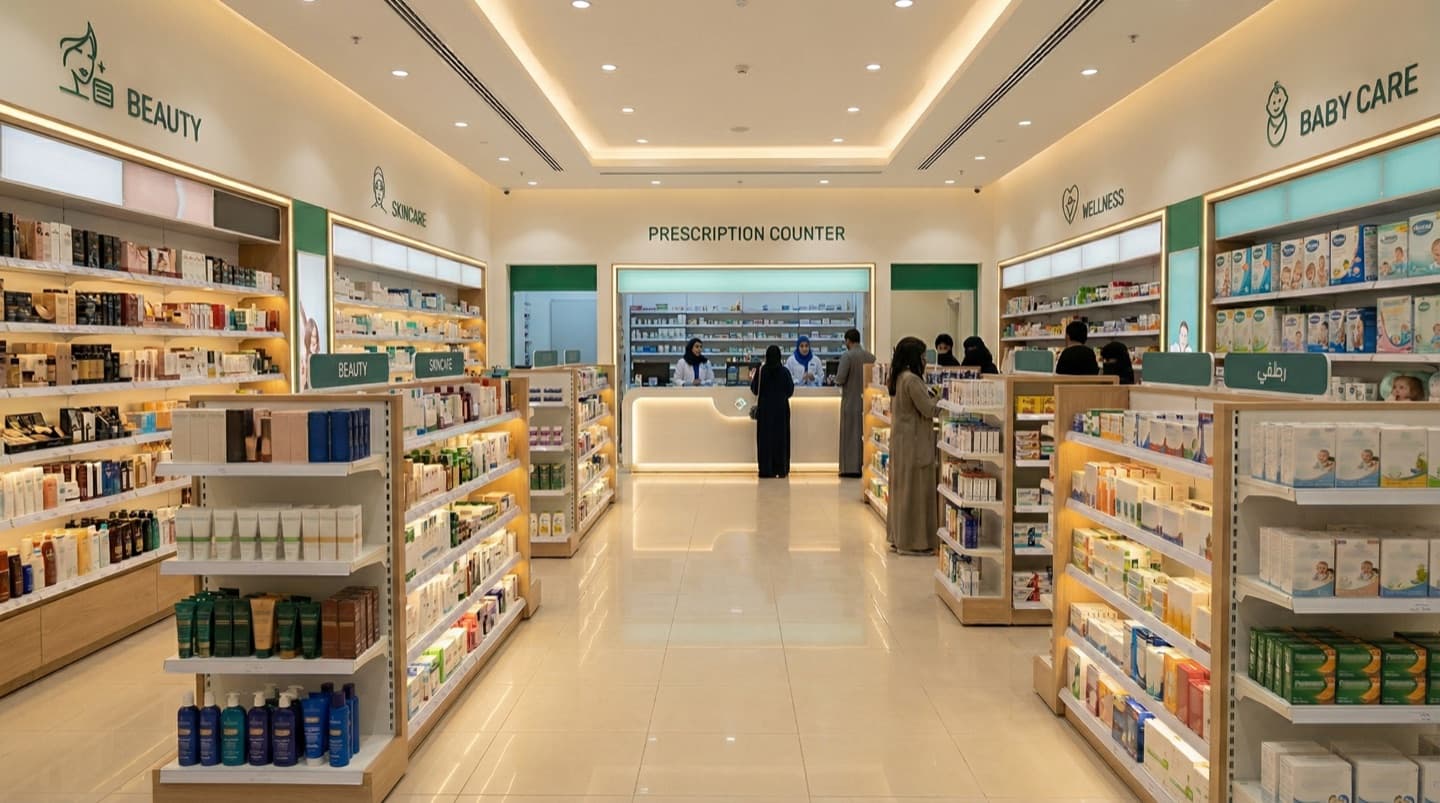
Three things shape the counter in the region. First, the market has both large pharmacy chains and independent pharmacies, and they work differently: chains often set planograms, promotions and access to staff training centrally, while an independent owner decides on the spot. The guide to pharmacy channel management in KSA covers that split in detail. Second, the counter is multilingual. Shoppers may ask in Arabic or English, and counter teams often come from several countries, so the product story needs to work in both languages. Third, what may be said about an OTC product, on pack, in advertising and by the people promoting it, is regulated by the Saudi Food and Drug Authority (SFDA). Which products may be sold without a prescription at all is also set by the regulator; the Saudi OTC medicines list explains how to check a product’s status.
What Questioning Protocols Do Pharmacy Teams Use at the Counter?
Short answer: the two best known are WWHAM and ASMETHOD, both widely used in UK community pharmacy practice training. They make sure the person behind the counter asks about the patient, the symptoms and other medicines before recommending anything. A rep who knows them can build product training that fits the way pharmacy teams already think.
Both are mnemonics: short memory aids that list the questions to ask when someone describes a symptom. They are not sales tools. Their purpose is to decide whether the shopper can be helped with a non-prescription product at all, and if so, which one suits them. That is exactly why a responsible brand should support them.
WWHAM
- Who is it for? The shopper, a child, an elderly parent?
- What are the symptoms?
- How long have the symptoms been present?
- Action already taken: what has the person tried so far?
- Medication: what other medicines is the person taking?
ASMETHOD
ASMETHOD was developed in UK community pharmacy practice and is usually attributed to Derek Balon. It is longer and more thorough:
- Age and appearance of the patient
- Self or someone else: is the shopper the patient?
- Medication the patient is already taking
- Extra medicines: anything else, including herbal and other products
- Time persisting: how long the problem has lasted
- History: any relevant medical history, previous episodes
- Other symptoms alongside the main complaint
- Danger symptoms that need referral
| WWHAM | ASMETHOD | |
|---|---|---|
| Number of questions | Five | Eight |
| Typical user | Counter assistants and pharmacists in quick, routine conversations | Pharmacists, and less straightforward cases |
| Strength | Short and easy to remember under pressure | Asks explicitly about history and danger symptoms |
| What the rep takes from it | Build the product story around the answers to these five questions | Make the product’s limits and referral points clear for each step |
How does a rep support these protocols?
The practical step is to map your product onto the questions. For each one, write what answer makes your product a good fit and what answer rules it out. “Who is it for?” becomes the age groups and patient types in the approved leaflet. “How long?” becomes the duration after which the leaflet says to see a doctor. “Medication?” becomes the known interactions. When your training material follows the same order as the questions the pharmacy team already asks, the team can use it without translating it into their own process.
When Must the Counter Refer to a Doctor Instead of Selling?
Short answer: whenever the questions reveal danger symptoms, symptoms that have lasted longer than the product allows, a patient the product is not approved for, possible interactions, or a treatment that has already failed. A rep must never push a sale past a referral, and should treat a correct referral as the system working, not as a lost sale.
Red flags depend on the condition and are set out in the product’s approved information and in the pharmacy’s own protocols. As a brand, you do not write the clinical rules. You make sure your training repeats them clearly. Typical categories that pharmacy training covers include:
- Duration. Symptoms that have lasted longer than the period the leaflet allows for self-treatment.
- Severity. Severe pain, high fever, difficulty breathing, chest pain, or a shopper who looks very unwell.
- Warning signs. Blood where it should not be, unexplained weight loss, or symptoms that do not match a common minor ailment.
- Patient group. Babies and young children, pregnancy and breastfeeding, older patients, and people with long-term conditions, where the product’s approved use may be restricted.
- Other medicines. Possible interactions, or a symptom that may be a side effect of another medicine.
- Repeat or failure. The same problem coming back again and again, or an OTC treatment that has already been tried without effect.
I tell every field team the same thing: a counter assistant who refers a shopper correctly, even when your product was on the counter, has done exactly what you trained them to do. If your training only ever ends in “and then recommend Brand A”, the pharmacy team will notice, and they will trust your next visit a little less.
How Should a Rep Train Counter Staff in a Short In-Pharmacy Session?
Short answer: keep it to a few minutes, one product and one story: which symptoms it fits, who it does not suit, how to use it, and when to refer. Use only approved claims, speak in the team’s working language, and leave a simple card behind. Agree the timing with the pharmacist in charge so the counter is never left unattended.
Counter staff have little time and many products. A long product presentation competes with shoppers at the counter and loses. The sessions that work in my experience are short, repeated and built around a real counter question. Here is a structure I recommend:
- The one product story. One sentence that says what the product is for and why it is a good choice for a specific shopper. Not a list of five benefits.
- Which symptoms it fits. The approved indications, in the words a shopper would use, mapped onto the WWHAM questions.
- Who it does not suit. Age limits, contraindications, interactions and the referral points. Say this part as clearly as the benefits.
- Dose and use. How much, how often, for how long, with or without food, and the one mistake shoppers commonly make with this type of product.
- Approved claims only. Nothing the approved materials do not support, and no comparison with a named competitor unless the approved material makes one.
- A practice question. Ask one of the team to play the shopper and another to answer. It shows you whether the story landed.
- Something to keep. A small, approved reference card in Arabic and English with the questions, the fit, the limits and the dose.
In a chain, check first whether staff training needs head office approval and whether the chain has its own training calendar. In an independent pharmacy, the owner or pharmacist in charge decides. Either way, ask the pharmacist to be present or to approve the content: you are training their team, under their responsibility. The broader skills behind a good session are covered in the guide to pharma selling skills.
What Does a Good Counter Conversation Look Like, Step by Step?
Short answer: greet, ask, match, explain the dose and use, add a related product only when it is clinically relevant, close, and give follow-up advice. The questions come before any product, and every conversation ends with clear advice on when to come back or see a doctor.
This is the sequence a rep can help the pharmacy team practise. It is written from the point of view of the person behind the counter.
| Step | What the counter staff member does | What to avoid |
|---|---|---|
| 1. Greet | Acknowledge the shopper quickly, in the language they used, and give them attention | Starting with a product before the shopper has finished speaking |
| 2. Ask | Use WWHAM (or ASMETHOD for less simple cases); ask the pharmacist if anything is unclear | Skipping the medication question because the counter is busy |
| 3. Match | Choose a product that fits the answers, or refer; offer a choice where more than one suits | Recommending the same product for every version of a symptom |
| 4. Explain dose and use | How much, how often, how long, and the common mistake to avoid | Handing over the pack with no explanation |
| 5. Add-on, only if relevant | Suggest a related product when it genuinely helps this shopper’s situation | A fixed add-on offered to everyone |
| 6. Close | Confirm the choice, check the shopper understood, and complete the sale | Pressure, or an upsell to a bigger pack the shopper does not need |
| 7. Follow-up advice | Say when to expect improvement and when to come back or see a doctor | Ending the conversation at the payment |
Shoppers sometimes push back at the counter: on price, on a brand they saw advertised, or on whether they need anything at all. The same calm, question-first approach applies, and it is close to what reps do with pharmacists; see the guide to objection handling in pharma sales.
Is Link-Selling Ethical, and Where Does It Become Pushing?
Short answer: link-selling (suggesting a related product) is ethical when it answers a real need that came up in the questions, such as a saline spray alongside a cold remedy for someone with a blocked nose. It becomes pushing when the add-on is the same for everyone, is not relevant to the symptoms, or is driven by an incentive rather than the shopper.
A good test is to imagine the shopper hearing the reason for the suggestion. “Because you said your skin is very dry, this moisturiser will help alongside the cream” passes. “We always suggest this one” does not. Cialdini’s principle of commitment and consistency, the tendency to act in line with a choice already made, explains why add-ons are easy to say yes to once a shopper has decided on the main product. That is exactly why they need restraint. An easy yes is not the same as a good recommendation.
For a brand, the practical rule is to train link-selling as part of the clinical story, never as a separate sales target. If your range has products that genuinely go together for a condition, explain the situations where both are useful and the situations where one is enough. Leave the decision to the pharmacy team.
FreeScore your brand plan before management does. Send me the scorecard
What Role Do Shelf Position, POSM and Counter Units Play?
Short answer: they support the conversation but do not replace it. A product that is in stock, visible and in the right place is easy to recommend and easy to find for self-selection shoppers. POSM (point-of-sale materials) and counter units remind staff and shoppers of the product, but only within the pharmacy’s rules and the approved claims.
Paco Underhill’s Why We Buy (1999), built on years of observing shoppers in stores, made the point that what shoppers see and where they stand shapes what they buy. One of his observations is that people need a moment to adjust after entering a store, so materials placed right at the entrance are often missed. In a pharmacy, the counter and the shelves next to it are where attention naturally rests while the shopper waits.
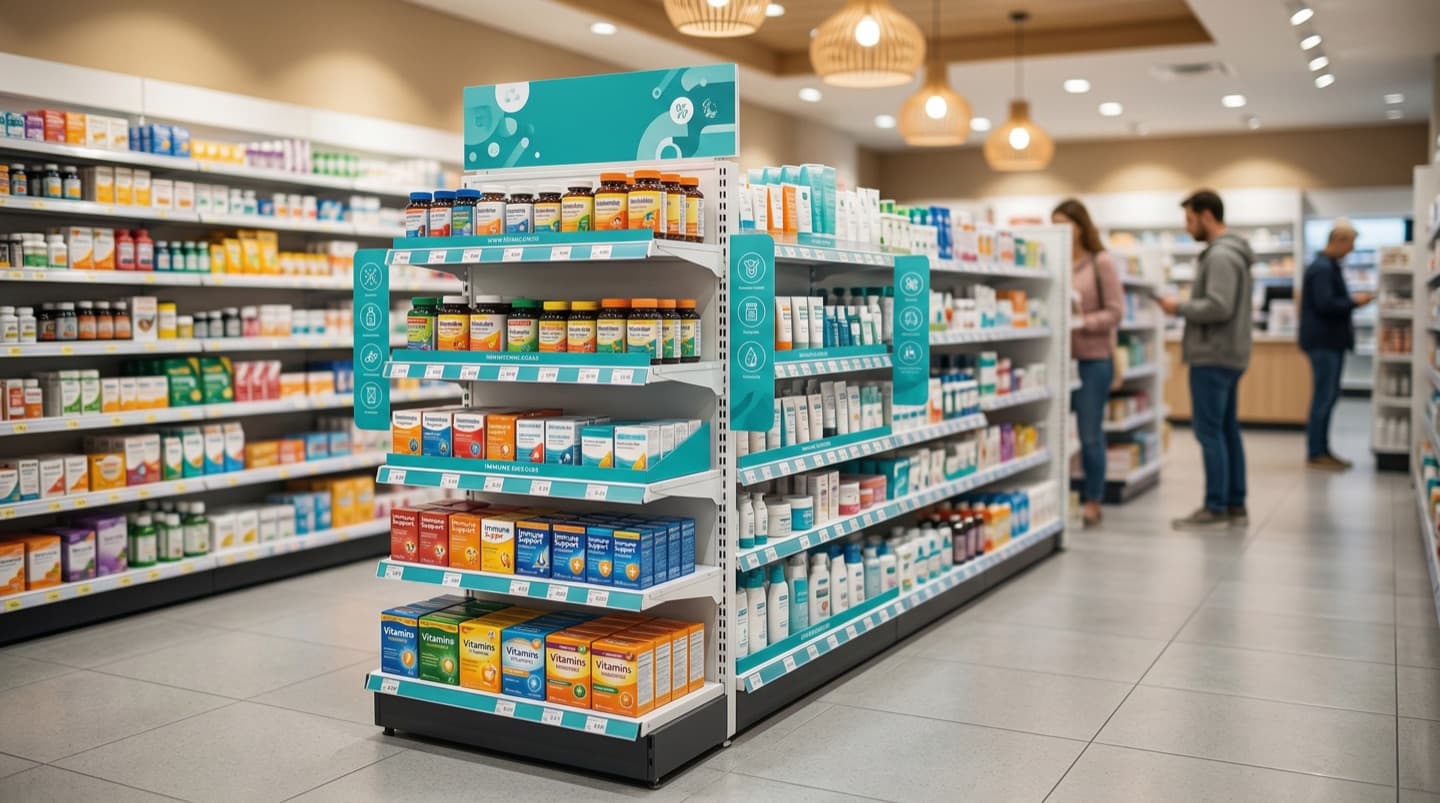
For counter selling, three shelf points matter most. The product must be in stock, because a recommendation for something that is not there turns into a recommendation for something else. It must sit in its category where staff expect to find it. And any counter unit or shelf material must carry only approved messages and follow the pharmacy’s or chain’s rules on display. The detail of planograms, facings and in-store material is in the guide to pharmacy merchandising strategies, and the wider picture of how brands fund and plan this work is in trade marketing in the pharmaceutical industry.
What May a Pharmacy Promoter Do, and What Not?
Short answer: an in-store promoter helps shoppers find and understand the brand within its approved information, and keeps the shelf in order. A promoter does not diagnose, give medical advice, recommend medicines that need the pharmacist’s judgement, disparage competitors or override the pharmacist.
Promoters are common in the region, especially in skincare, mother and baby, and other consumer-health categories, and in large chain branches. They are employed or contracted by the brand, not by the pharmacy, which is exactly why their role needs clear limits. A shopper in a pharmacy may not know the difference between a promoter and a member of the pharmacy staff.
| A promoter may | A promoter should not |
|---|---|
| Greet shoppers in the brand’s area and help them find products | Diagnose a condition or ask clinical questions that belong to the pharmacist |
| Explain the brand’s approved information and demonstrate use where relevant | Make claims beyond the approved materials |
| Keep the brand’s shelf tidy, faced and stocked from the pharmacy’s stock | Recommend a medicine where the pharmacist’s judgement is needed |
| Refer any health question to the pharmacist | Disparage competing products or move them off the shelf |
| Report stock, display and shopper questions to the rep | Override or contradict the pharmacist in front of a shopper |
Chains usually have their own written rules for promoters, covering where they may stand, what they may wear and what they may hand out. Read them before placing anyone. A promoter who is welcome in the branch is worth far more than one the branch manager tolerates.
What Are the Compliance Limits on Incentives to Counter Staff?
Short answer: in Saudi Arabia, incentives connected to medicines fall under the SFDA’s rules on the promotion of OTC products and the code that governs pharmaceutical promotional practices in the Kingdom, plus your company’s policy and each chain’s rules. Anything that rewards an individual for recommending a specific medicine works against responsible recommendation. Check the current rules with your compliance team before offering anything.
I will not quote numeric limits or article numbers here, because rules change and the authority is the SFDA’s current text, not a blog post. What I can give is the principle that has kept the teams I work with out of trouble. Commercial terms belong in written agreements between the brand and the pharmacy business: listing, display, promotions and their documentation. Personal rewards to the person whose advice the shopper is trusting are a different matter. A counter assistant who earns something for each pack of Brand A is no longer giving neutral advice, and the shopper cannot see that.
Pharmacists are healthcare professionals, and codes of promotional practice generally treat gifts and hospitality to healthcare professionals with care. Educational activity, such as a training session on a condition, is usually a safer and more useful way to build a relationship than anything with a cash value. The SFDA marketing compliance checklist sets out the points a brand team should check, and if you are bringing a new product to market, the guide to an OTC product launch in Saudi Arabia covers how counter training fits into the launch plan.
How Do You Measure Counter Performance?
Short answer: with two kinds of evidence. Sell-out data tells you how much moved through the pharmacies you work with. Mystery shopping tells you what happens in the conversation: whether staff asked the right questions, what they recommended, and whether they referred when they should have.
Sell-out
Sell-out means sales from the pharmacy to the shopper, as opposed to sell-in, sales from the brand or distributor to the pharmacy. Chains may share sell-out data under an agreement; for independents, brands often rely on distributor data or third-party market data. Compare trained and untrained pharmacies, and the same pharmacies before and after training, while keeping in mind that promotions, stock and seasonality also move the numbers.
Recommendation share through mystery shopping
Recommendation share is how often your product is recommended when a shopper asks for help with a symptom your product treats. It is measured with mystery shopping, and the method matters more than the headline number:
- Write a few fixed scenarios. For example, an adult with a dry cough for two days, taking no other medicines. Include at least one scenario where the right answer is a referral, so you measure quality and not only brand mentions.
- Choose a sample of pharmacies. Mix chains and independents, cities and regions, and trained and untrained stores.
- Use trained shoppers and a simple form. Did staff ask who it was for, about duration and about other medicines? What was recommended first? Was a choice offered? Was dose explained? Was a referral given when it should have been?
- Repeat the same scenarios over time. One round is a snapshot; the trend across rounds is what tells you whether training works.
- Share results as coaching, not punishment. Report back by store or area, and use the findings to improve the next training session.
Two cautions. Mystery shopping takes real time from pharmacy staff, so keep it proportionate and follow any rules your market research partner and the chains apply. And a high recommendation share with poor questioning scores is a warning, not a success: it suggests the product is being recommended out of habit, including to shoppers it may not suit.
A Pharmacy Visit Checklist for OTC Reps
Short answer: on each visit, check stock and shelf first, then speak with the pharmacist, then train or refresh the counter team, and finish by agreeing one next step. The table below can be used as it is.
| Area | Check | Done when |
|---|---|---|
| Before the visit | Last visit notes, sell-out trend, open issues, the one message for this visit | You can say the purpose of the visit in one sentence |
| Stock | Every listed product in stock; expiry dates; back stock | Out-of-stocks noted and an order agreed with the pharmacist |
| Shelf | Position in the category, facings, price labels, planogram where one exists | Shelf left better than you found it, within the pharmacy’s rules |
| POSM and counter units | Approved materials only, in good condition, allowed by the pharmacy | Old or damaged material removed |
| Pharmacist | Questions from shoppers, feedback on the product, any reported side effects | Side effects passed on through the company’s reporting process the same day |
| Counter team | Who is new, who has been trained, which questions they find hard | Short session or refresher done, card left in Arabic and English |
| Referral points | Staff can name who the product does not suit and when to refer | At least one team member explains the limits back to you |
| Promoter (if any) | Working within the agreed role and the chain’s rules | Issues raised with the branch manager and your manager |
| Compliance | Claims, materials and anything offered stay within SFDA rules and company policy | Nothing left or promised that you would not show your compliance team |
| Close | One agreed next step and date | Visit logged in the CRM the same day |
What Are the Most Common Mistakes in Counter Selling?
Short answer: pushing past a referral, long training sessions nobody remembers, claims beyond the approved materials, personal incentives that distort advice, and measuring only volume. Each one trades long-term trust for a short-term sale.
- Treating a referral as a lost sale. It is the protocol working. A brand that complains about referrals loses the pharmacist’s trust.
- Product first, questions later. Training that starts with the brand instead of the shopper’s symptoms teaches staff to skip WWHAM.
- Too much in one session. Five products in fifteen minutes means none are remembered. One product, one story.
- Hiding the limits. If staff do not know who the product does not suit, they cannot recommend it safely.
- Unapproved claims. A rep who improvises a claim at the counter puts the brand, the company and the pharmacy at risk.
- Personal rewards for recommendations. They distort advice and sit uneasily with the rules on promotion.
- English-only material. In the GCC, many counter conversations happen in Arabic. Material needs to work in both languages.
- Ignoring the shelf. The best counter story fails if the product is out of stock or cannot be found.
- Promoters without limits. A promoter who acts like a pharmacist creates risk for the brand and friction with the branch.
- Measuring volume only. Sell-out without mystery shopping cannot tell you whether the counter conversation is good, or merely habitual.
Key Takeaways
- The counter recommendation often decides which OTC product goes home, especially when a shopper asks “what do you recommend?”
- Brands earn that recommendation by making it easy and safe, not by pushing
- Build training around WWHAM and ASMETHOD, the questioning protocols pharmacy teams already use
- Make referral points as clear as benefits, and never push a sale past a referral
- Train counter staff in short sessions: one product story, the symptoms it fits, who it does not suit, dose and use, approved claims only
- Link-selling is ethical only when it answers a need that came up in the questions
- Keep promoters inside a clear role and the chain’s rules
- Keep incentives within the SFDA’s rules and company policy; avoid personal rewards for recommendations
- Measure with sell-out and mystery shopping, and watch questioning quality, not only brand mentions
Frequently Asked Questions
What is pharmacy counter selling?
Pharmacy counter selling is the conversation in which a pharmacist or counter assistant helps a shopper choose a non-prescription medicine or consumer-health product. For an OTC brand it is the moment that decides whether the shopper leaves with your product, a competitor's, or a referral to a doctor. Done well, it starts with questions about the person and the symptoms, not with a product.
What does WWHAM stand for in pharmacy?
WWHAM stands for Who is it for, What are the symptoms, How long have they had them, Action already taken, and Medication already being taken. It is a questioning mnemonic widely used in UK community pharmacy training so that counter staff gather the basic facts before recommending a product or referring the shopper.
What is the difference between WWHAM and ASMETHOD?
Both are questioning frameworks for responding to symptoms at the pharmacy counter. WWHAM has five short questions and suits counter assistants and quick conversations. ASMETHOD has eight: Age and appearance, Self or someone else, Medication, Extra medicines, Time persisting, History, Other symptoms and Danger symptoms. It is more thorough and is usually used by the pharmacist or for less straightforward cases.
How can an OTC rep get pharmacists to recommend their product?
By making the recommendation easy and safe for the pharmacist: one clear product story, the symptoms it fits, who it does not suit, the dose and use in plain words, and only approved claims. Train counter staff in short sessions, keep the product in stock and visible, and respect referrals. Pharmacists recommend brands they trust and understand, not brands that push hardest.
When should a pharmacist refer a customer to a doctor instead of selling an OTC product?
When questioning reveals danger symptoms, symptoms that have lasted longer than the product's leaflet allows, a patient group the product is not approved for, possible interactions with other medicines, or repeated treatment failure. The exact list depends on the condition and the product's approved information. A rep should never encourage a sale past a referral.
What can a pharmacy promoter do and not do?
An in-store promoter can help shoppers find products, explain the brand's approved information, demonstrate use where relevant, and keep the shelf in order. A promoter should not diagnose, give medical advice beyond the approved information, recommend medicines that need the pharmacist's judgement, disparage competitors or override the pharmacist. Each chain also has its own rules for promoters.
Are incentives to pharmacy counter staff allowed in Saudi Arabia?
Incentives are governed by the SFDA's rules on the promotion of medicines and the code that governs pharmaceutical promotional practices in the Kingdom, along with company policy and each chain's own rules. Anything that rewards an individual for recommending a specific medicine conflicts with responsible recommendation. Check the current SFDA rules and your compliance team before offering anything to pharmacy staff.
How do you measure counter recommendation for an OTC brand?
Combine sell-out data for the pharmacies you work with and mystery shopping. A mystery shopper presents a set, scripted symptom scenario in a sample of pharmacies and records whether staff asked questions, what they recommended, and whether they referred when they should have. Repeating the same scenarios over time shows your recommendation share and the quality of the counter conversation.
What to Do Next
Take your lead OTC product and map it onto the five WWHAM questions today: for each one, write the answer that makes it a good fit and the answer that rules it out. That single page is the core of your next counter training session, and it will show you quickly whether your current materials make the limits as clear as the benefits.
If you work in Saudi Arabia, booklet 18 of the Field Booklets, “The Promoter”, covers the in-store promoter’s role in a short practical format in Arabic and English, and booklet 10, “Shelf and Visibility”, goes deeper into the stock and shelf side of each visit. The first booklet is a free sample.